Why Aren't All LED Grow Lights Delivering the Same Yields? The Science of Spectral Tuning for Hydroponic Success
Two hydroponic farms can grow the same crop in similar nutrient solutions and still produce noticeably different yields under LED lighting. The difference is not necessarily electrical power, fixture price, or the number of diodes. Often, the more important variables are the spectrum reaching the leaves, the intensity at canopy level, the daily quantity of light, and how these factors interact with temperature, nutrition, and crop development.
LED grow light spectral tuning is the process of adjusting the wavelengths and relative amounts of light supplied to plants to suit a particular crop, growth stage, or production objective. When combined with appropriate photosynthetic photon flux density (PPFD) and daily light integral (DLI), spectral tuning can help hydroponic growers manage plant architecture, biomass production, flowering, and product quality more deliberately.
The central principle is straightforward: light should be managed as a biological input rather than treated simply as an electrical appliance. A productive lighting strategy begins with the crop's requirements, measures the photons reaching the canopy, and then adjusts the spectrum and photoperiod within the limits imposed by the growing environment.
Why Identical Wattage Does Not Guarantee Identical Yields
Electrical wattage describes how much power a fixture consumes. It does not directly tell a grower how many photosynthetically useful photons reach the plants, how evenly those photons are distributed, or whether the delivered spectrum suits the crop.
Consider two fixtures that each consume the same electrical power. One may convert more electricity into photosynthetic photons, while the other may distribute its output more effectively across the growing area. Even if their total photon outputs are similar, differences in beam angle, mounting height, canopy coverage, and spectral distribution can change the light received by individual plants.
Four variables explain much of this difference:
- Photon output: How many photons in the relevant wavelength range the fixture produces per second.
- Canopy distribution: How evenly those photons reach plants across the growing area.
- Spectrum: How the available photons are distributed among wavelengths.
- Daily exposure: How much light the plants accumulate over the entire lighting period.
Plant response introduces another layer of complexity. Lettuce, basil, strawberries, tomatoes, and young transplants do not necessarily respond identically to the same spectrum or light intensity. Their leaf structure, developmental stage, architecture, and harvest objectives differ.
This is why a high-wattage fixture can underperform in a poorly designed hydroponic system, while a lower-power fixture with suitable photon efficacy, coverage, and control may deliver better results per unit of electricity.
PPFD and DLI: The Measurements That Make Lighting Useful
Spectral tuning becomes much more meaningful when it is supported by reliable light measurements. Two quantities are particularly important in controlled-environment agriculture: PPFD and DLI.
Understanding photosynthetic photon flux density
Photosynthetic photon flux density measures the number of photosynthetically active photons arriving at a surface each second. It is normally expressed in micromoles per square meter per second (µmol/m²/s), commonly measured across the photosynthetically active radiation range of 400–700 nanometers.
In practical terms, PPFD describes the instantaneous light intensity at a particular location on the crop canopy. A fixture specification showing total photon output does not establish the PPFD at every plant because mounting height, optics, shelf dimensions, and overlapping light beams influence the final result.
Measure PPFD at canopy height at multiple locations, including corners, edges, and the center of the growing area. A single reading directly below a fixture may conceal poorly illuminated plants elsewhere.
Understanding daily light integral
DLI measures the total photosynthetically active photons received per square meter over a day. Its unit is mol/m²/day. It combines light intensity with the duration of exposure, making it useful when comparing different combinations of brightness and photoperiod.
For a constant PPFD throughout the lighting period, the calculation is:
DLI = PPFD × lighting hours × 3,600 ÷ 1,000,000
For example, a canopy receiving an average PPFD of 250 µmol/m²/s for 16 hours accumulates:
250 × 16 × 3,600 ÷ 1,000,000 = 14.4 mol/m²/day
This calculation provides a useful starting point, not a universal target. Appropriate DLI depends on crop species, cultivar, growth stage, temperature, carbon dioxide availability, and production goals. A DLI that supports rapid growth in one crop may be excessive for another or unsuitable for a young transplant.
When natural sunlight also reaches a greenhouse, include that contribution in the daily light budget. Supplemental LED lighting should be calculated against the total exposure rather than treated as if the lamps were the only source.
Why average values can be misleading
Two shelves can have the same average PPFD but different distributions. One may illuminate every plant relatively evenly; the other may contain intense central hotspots and dim edges. Plants in the dimmer areas may grow more slowly, while the hotspots may experience unnecessary energy input or excessive light stress.
For that reason, record both the average and the range of measurements across the canopy. Recheck them whenever plants grow taller, fixtures move, or crop spacing changes.
What Different Light Wavelengths Actually Do
Plants detect light through several photoreceptor systems and photosynthetic processes. Wavelengths can influence both carbon assimilation and developmental signals, but their effects depend on intensity, exposure, genotype, and the surrounding environment.
These ranges are useful for understanding the major spectral regions, but they are not independent switches for controlling a single plant trait. A wavelength that influences compact growth may also affect photosynthesis or development in ways that depend on the crop and its environment.
Red and blue photons are important, but a productive spectrum does not have to exclude green wavelengths. Green light can contribute to canopy photosynthesis, particularly where light must penetrate layers of leaves. Likewise, far-red radiation can affect plant development and photosynthetic responses even though conventional PPFD meters may not fully represent its contribution.
The useful question is therefore not whether a fixture has the highest possible proportion of a particular color. It is whether the complete spectral distribution supports the intended crop outcome at an appropriate total photon dose.
How to Tune Spectrum for Different Crops and Growth Stages
A useful spectral recipe starts with the crop's biological requirements and the commercial objective. The objective may be rapid vegetative growth, compact transplant production, consistent flowering, fruit development, or a particular balance between fresh weight and quality attributes.
Leafy greens and herbs
Lettuce, spinach, and many leafy greens are often managed for leaf expansion, fresh biomass, texture, and consistent harvest timing. A balanced broad spectrum can support these objectives while allowing growers to adjust blue and red proportions as needed.
Basil and other culinary herbs introduce a different consideration: aroma, pigmentation, and secondary metabolite profiles may matter alongside total biomass. Light spectrum can influence some quality traits, but the response is cultivar-specific and may vary with temperature, nutrient availability, and harvest age.
If leafy greens are stretching excessively, first check canopy PPFD, plant density, temperature, and the overall light environment. Adjusting blue-light proportion may help in some systems, but it should not substitute for correcting inadequate intensity or excessive crowding.
Tomatoes, peppers, and other fruiting crops
Fruiting crops require coordinated vegetative growth, flowering, fruit set, and fruit development. Their lighting needs change with canopy size and production stage, while fruit quality also depends heavily on temperature, irrigation, pollination, and nutrient management.
Red-rich spectra can contribute to productive photosynthesis, while blue and far-red wavelengths may influence architecture and developmental signaling. The appropriate balance depends on the cultivar and whether the priority is compact growth, canopy development, flowering behavior, or fruit production.
A spectral adjustment should not be expected to repair poor pollination, excessive root-zone salinity, or temperatures outside the crop's preferred range. Those limitations must be addressed separately.
Seedlings and transplants
Young plants have smaller canopies and different structural requirements from mature crops. Excessive intensity can stress seedlings, while inadequate light can contribute to weak, elongated growth. Spectrum, PPFD, irrigation, and temperature should therefore be adjusted together.
Begin with a conservative intensity appropriate to the species and developmental stage. Increase exposure gradually while monitoring leaf color, leaf expansion, stem strength, and signs of stress. Avoid transferring a mature-plant lighting schedule directly to newly germinated seedlings.
Flowering and fruit development
Some crops respond to photoperiod, and others have flowering responses influenced by phytochrome signaling or interactions between light and temperature. Far-red supplementation can alter developmental responses in certain species, but the outcome is not universal.
If a crop depends on a specific day-length signal, preserve the correct light and dark schedule before experimenting with spectral changes. A spectrum that supports vegetative growth may not produce the same developmental response during flowering.
Why Tunable LED Systems Need a Controlled Adjustment Strategy
Tunable LED grow light systems allow operators to adjust the relative output of different wavelength channels, and some also support dimming, scheduling, and automated environmental integration. This flexibility can be useful, but it introduces a measurement problem: changing a channel can change both the spectrum and the total photon output.
For example, increasing a blue channel while reducing red output may change plant morphology and lower the total PPFD. If plants subsequently grow more slowly, the cause may be the reduced photon dose rather than the altered spectrum itself.
To separate these effects, change one major variable at a time and measure the resulting light field. When the objective is to compare spectra, keep total PPFD and photoperiod as consistent as practical. When the objective is to change daily exposure, hold the spectral recipe steady while adjusting intensity or duration.
Document each setting as a repeatable recipe, including channel percentages, measured PPFD, lighting hours, crop stage, canopy height, and environmental conditions. Channel percentages alone are insufficient because different fixtures can produce different photon distributions at the same nominal settings.
Use feedback instead of a fixed schedule alone
A smart hydroponic installation can combine dimmable LED drivers, timers, canopy-level light sensors, environmental monitoring, and a controller that responds to changing conditions. In greenhouses, daylight sensors can help reduce artificial lighting when sunlight already provides sufficient exposure.
However, automation works only when the control logic reflects the crop's requirements. A sensor that measures visible brightness in lux is not a substitute for a properly calibrated quantum sensor when the goal is to quantify PPFD. Human vision and plant photosynthetic responses do not weight all wavelengths equally.
Likewise, an automated system should not increase intensity indefinitely whenever the DLI falls behind its target. Temperature, humidity, airflow, root-zone conditions, electrical capacity, and the remaining photoperiod constrain how safely the deficit can be corrected.
Environmental Factors That Can Override a Good Spectrum
Light is only one part of the crop-production system. Even a carefully tuned spectrum cannot deliver its expected benefits if another factor limits photosynthesis, nutrient uptake, or growth.
- Carbon dioxide: Carbon assimilation depends partly on CO₂ availability. Increasing light beyond the point that the crop can use it efficiently may provide diminishing returns when CO₂ is limiting.
- Temperature: Photosynthetic performance, respiration, leaf development, and flowering respond to temperature. The optimum varies by species and growth stage.
- Humidity and vapor pressure deficit: Atmospheric moisture conditions influence transpiration and stomatal behavior. An unsuitable moisture balance can constrain the response to additional light.
- Nutrition and root-zone conditions: Nutrient imbalances, inappropriate pH, high electrical conductivity, low dissolved oxygen, and root disease can suppress growth regardless of the light recipe.
- Airflow and canopy structure: Dense foliage can create uneven illumination and microclimates, reducing the benefits of additional photons.
- Photoperiod: Daily exposure must account for species-specific responses to day length and the need for an appropriate dark period.
These interactions explain why the same LED configuration can perform differently between facilities or seasons. If increasing PPFD produces little improvement, investigate the entire production environment rather than assuming the spectrum needs another adjustment.
How to Evaluate Whether Spectral Tuning Improves Yield
Yield comparisons require more than observing that one batch appears larger. A useful evaluation separates changes in plant development from differences in total light exposure, environmental conditions, and crop management.
Start by establishing a baseline with a stable lighting recipe. Record crop variety, plant age, planting density, nutrient conditions, temperature, photoperiod, PPFD distribution, and DLI. Then introduce a specific adjustment and compare the outcome with a control group grown under otherwise comparable conditions.
Measure results that reflect the actual production goal. For leafy crops, this might include marketable fresh mass per plant, harvest weight per square meter, crop cycle duration, and the proportion of plants meeting quality standards. For fruiting crops, track marketable fruit mass, fruit count, size distribution, and relevant quality attributes.
Energy efficiency should also be included. A lighting change that increases harvest weight but consumes substantially more electricity may be less attractive than a smaller yield improvement achieved with lower energy input. Consider electricity use per kilogram of marketable produce, not only total harvest weight.
Whenever possible, repeat the comparison across multiple crop cycles. A single harvest can be affected by normal biological variation, localized environmental differences, or measurement error. Consistent results across repetitions provide stronger evidence that the adjustment is useful.
Limitations, Trade-Offs, and Common Misconceptions
Spectral tuning is valuable, but its benefits are not unlimited. A specialized recipe may improve one trait while reducing another. More compact plants, for example, are not automatically more productive if their total biomass or harvest quality declines.
Similarly, a change that improves pigmentation or a particular secondary metabolite may not increase fresh weight. Whether that change is desirable depends on the crop's intended market and the value of the resulting quality attribute.
Another limitation is the difficulty of separating spectrum from photon dose. If a new recipe changes several LED channels simultaneously, the total PPFD may also change. Without measuring both, growers cannot confidently attribute the result to spectral composition alone.
Not every facility needs independently adjustable channels. A stable, broad-spectrum fixture can be a sensible approach when the crop mix is consistent, the lighting schedule is established, and there is little operational benefit to changing spectral recipes. Tunability becomes more useful when crop stages, varieties, or production objectives genuinely differ and the facility can measure the consequences.
A Practical Checklist for Hydroponic Lighting Optimization
Before changing a spectral recipe, work through the following checklist. It helps distinguish a genuine spectrum problem from a measurement issue or an unrelated crop-production constraint.
- Identify the crop, cultivar, developmental stage, harvest objective, and intended crop cycle.
- Measure PPFD at multiple canopy positions instead of relying on fixture wattage or a single central reading.
- Calculate DLI from measured light exposure and photoperiod, including sunlight where relevant.
- Check canopy uniformity, mounting height, plant spacing, and changes in crop height.
- Confirm that temperature, humidity, airflow, CO₂ availability, irrigation, and root-zone conditions are suitable.
- Establish a baseline using a stable spectrum and record channel settings, PPFD, DLI, and environmental conditions.
- Change one major variable at a time whenever practical, keeping total photon exposure comparable when testing spectral effects.
- Monitor visible stress, plant architecture, development, and the specific quality traits relevant to the crop.
- Compare marketable yield, crop-cycle duration, and electricity consumption rather than relying on visual impressions alone.
- Repeat the comparison and retain the recipe only when the result is sufficiently consistent and operationally useful.
The order matters. If the canopy receives too little light, correcting PPFD and DLI may deliver a more meaningful improvement than changing the spectrum. If the light field is already suitable, crop-specific spectral adjustments become a more informative next experiment.
Frequently Asked Questions
1. Does a higher-wattage LED grow light always produce higher yields?
No. Wattage measures electrical power consumption, not the amount or distribution of photosynthetically useful light reaching plants. Yield depends on photon output, canopy coverage, PPFD, DLI, spectrum, crop genetics, and environmental conditions. More electrical power can help when light is limiting, but it cannot guarantee a proportional increase in harvest.
2. Is a full-spectrum LED better than a red-and-blue grow light?
Not in every situation. A broad spectrum can support photosynthesis and provide useful flexibility across different crops, while red-and-blue systems can also support productive growth under suitable conditions. The relevant comparison is the spectrum delivered at the canopy, its photon efficacy, uniformity, and the crop's response—not the label alone.
3. What is the difference between PPFD and DLI?
PPFD describes the instantaneous rate at which photosynthetic photons reach a surface, measured in µmol/m²/s. DLI describes the accumulated daily quantity of those photons, measured in mol/m²/day. PPFD helps establish intensity at a particular moment, while DLI accounts for both intensity and exposure duration.
4. Can changing blue and red light increase biomass?
It can under some conditions, but the outcome depends on the crop, spectrum, intensity, developmental stage, and growing environment. A change in color balance may alter plant shape or leaf development without increasing total biomass. Comparisons should therefore control total PPFD and measure the production outcome that matters.
5. Should far-red light be included in every hydroponic lighting system?
No. Far-red can influence phytochrome signaling, canopy development, and photosynthetic interactions, but the response varies among crops and growing conditions. It may be useful for a specific developmental objective, yet it is not a universal yield enhancer. Evaluate its effect using a controlled trial and suitable measurements.
6. How many hours should LED grow lights operate each day?
There is no single correct schedule for every crop. Photoperiod should reflect the species, developmental stage, target DLI, available sunlight, and any flowering or dark-period requirements. Calculate daily exposure from measured PPFD and operating hours, and avoid extending the lighting period without considering the crop's biological response.
7. Can smart controllers automatically optimize the light spectrum?
Controllers can automate dimming, channel schedules, and responses to measured environmental conditions. However, automation does not establish the correct crop recipe by itself. Reliable control requires calibrated sensors, validated targets, appropriate safety limits, and data showing how a particular crop responds to different settings.
8. When is spectral tuning not worth the added complexity?
It may not be worthwhile when a facility grows one crop under a stable production schedule and a suitable broad-spectrum recipe already meets its yield and quality targets. If there is no measurable production benefit from additional channel control, a simpler system can reduce operational complexity. Tunability is most useful when it addresses a defined production problem or supports genuinely different crop requirements.
Conclusion: Optimize the Light Plants Receive, Not Just the Light Fixtures Consume
Consistent hydroponic yields depend on matching light delivery to crop biology. Spectral composition influences photosynthesis and developmental signaling, but its practical value becomes clear only when considered alongside PPFD, DLI, canopy uniformity, photoperiod, and the surrounding growing environment.
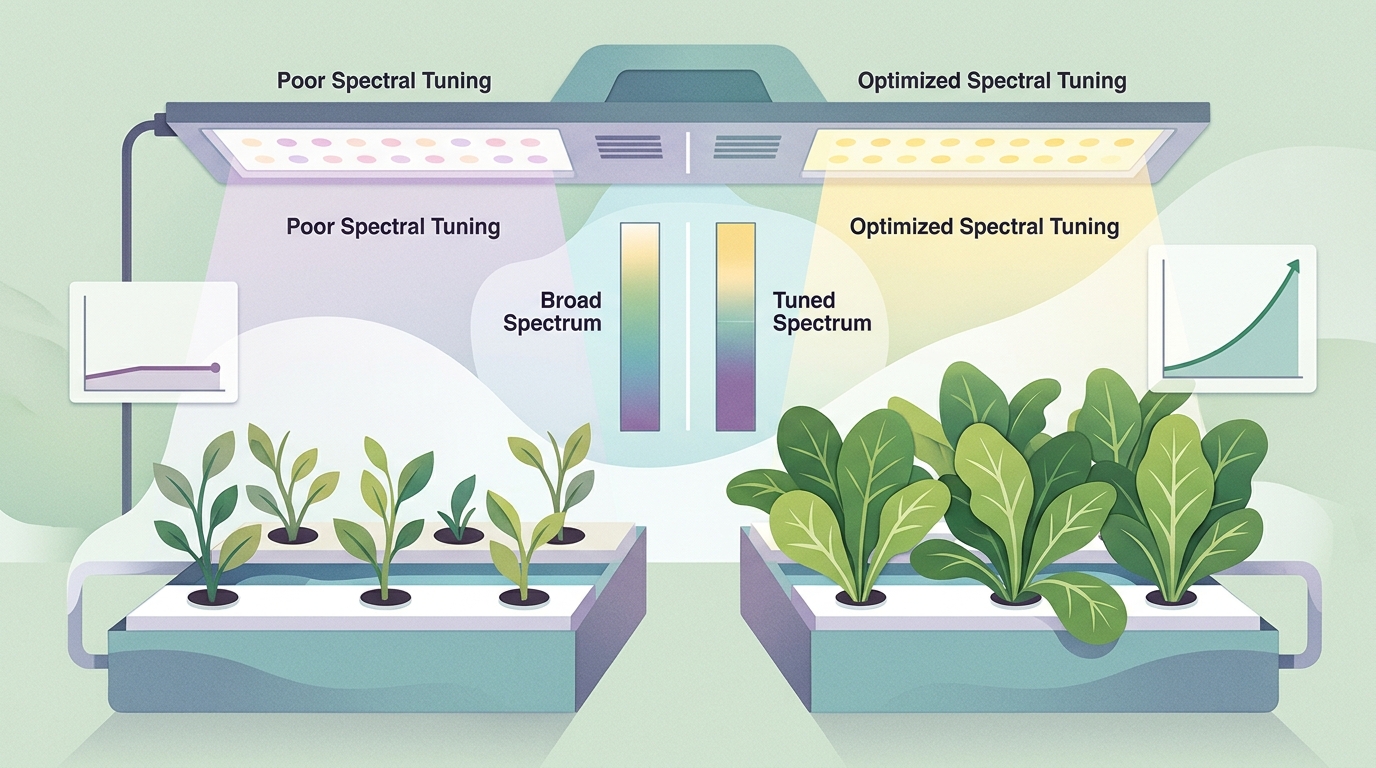
The most defensible optimization strategy is to measure the existing light field, identify the factor limiting production, and adjust the relevant variable in a controlled way. Correct uneven coverage before chasing color ratios, establish an appropriate daily photon budget before extending operating hours, and test spectral changes against a stable baseline rather than assuming a particular wavelength guarantees higher yields.
Tunable LED systems can make precision crop management more flexible, especially in facilities that grow different crops or manage several developmental stages. Their advantage, however, comes from informed control rather than adjustability alone. When measurements, crop-specific evidence, and harvest data guide each change, lighting becomes a more predictable component of smart hydroponic production instead of an expensive exercise in trial and error.


Comments
Post a Comment