What Critical Environmental Factor Is Often Missed by Automated Greenhouse Climate Systems?
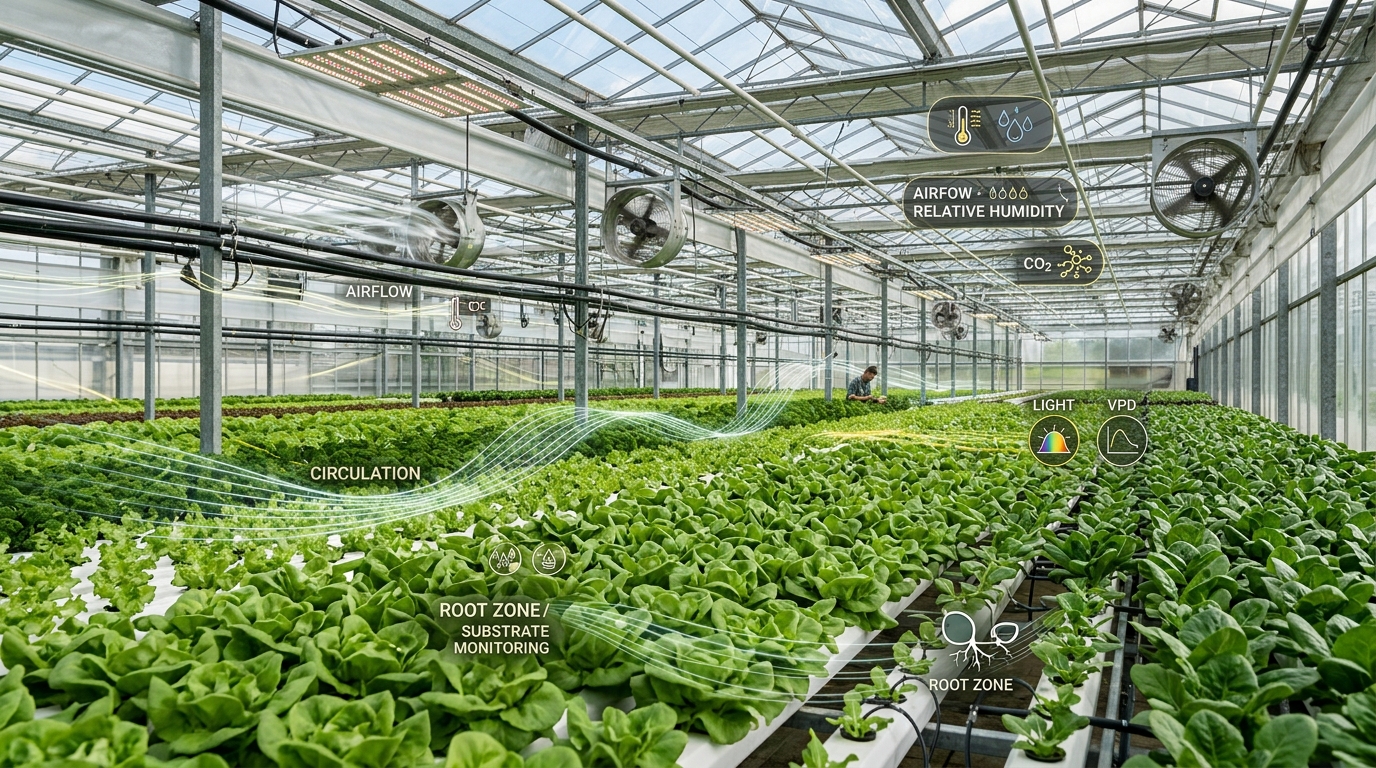
Key takeaway: Automated greenhouse climate control factors are not limited to temperature and relative humidity. A greenhouse can display an apparently comfortable air temperature while the crop is experiencing excessive evaporative demand, stagnant canopy air, depleted carbon dioxide, inadequate light, or a root zone that is thermally out of step with the foliage. The frequently missed issue is therefore not one magic sensor. It is the relationship between environmental variables at the crop itself.
This distinction matters because an automated controller can only respond to what it measures. If a temperature probe sits in a location that does not represent the crop canopy, a controller may make a technically correct decision for the sensor while making a poor decision for the plants. The same problem appears when relative humidity is interpreted without temperature, when greenhouse-wide CO2 is measured without considering the leaf canopy, or when ventilation is assumed to create uniform air movement.
The evidence from university extension programs points toward a broader model: greenhouse climate is a connected system involving heat, moisture, radiation, gas exchange, airflow, and the root environment. The practical question is not simply whether each value is inside a preferred range. It is whether the values are interacting in a way that supports the crop at the time and location where growth is occurring.
The overlooked variable is often VPD, but VPD is only part of the answer
Vapor pressure deficit, or VPD, is one of the most useful ways to expose a weakness in temperature-and-humidity-only automation. Relative humidity tells you how close the air is to saturation at its current temperature. VPD instead represents the difference between the amount of moisture the air could hold at a given temperature and the amount it actually contains. Because saturation vapor pressure changes strongly with temperature, the same relative humidity can correspond to different evaporative conditions.
That matters to plants because leaves exchange water vapor with the surrounding air through stomata. A controller that sees a moderate relative humidity reading may not recognize that a warmer canopy is experiencing a substantially different moisture demand. Conversely, a cool greenhouse can reach condensation conditions even when a simple humidity percentage does not look dramatic in isolation.
VPD should therefore be treated as a derived crop-environment indicator, not as a replacement for the underlying measurements. A calculated VPD value is only as representative as the temperature and humidity data used to calculate it. If the sensor is in direct sunlight, near a heater, beside a cooling inlet, or outside the crop canopy, the resulting VPD can misrepresent what leaves actually experience.
This is where the University of Alaska Fairbanks Cooperative Extension guidance on greenhouse air circulation becomes useful. Its discussion of greenhouse air movement explains that limited circulation can disturb gas exchange near leaves and allow humid conditions to develop around foliage. In other words, a greenhouse may have acceptable bulk-air measurements while the microenvironment immediately around leaves tells a different story.
Why temperature and relative humidity can look normal while the crop is not
Temperature and relative humidity remain fundamental measurements. The problem arises when automation treats them as complete descriptions of the crop environment.
Consider a dense canopy on a bright afternoon. The greenhouse controller may report an acceptable air temperature and humidity. Yet the crop can still have a weakly mixed boundary layer around the leaves. That layer changes how quickly water vapor and carbon dioxide move between the leaf surface and surrounding air. If the fans only circulate air above or below the crop, the controller may register movement without achieving the desired exchange at leaf level.
University of Alaska Fairbanks guidance specifically notes that air circulation helps maintain more uniform conditions, reduce humidity around leaf surfaces, and maintain gas exchange. It also distinguishes circulation within the greenhouse from the broader exchange of inside and outside air. That distinction is easy to lose in an automated system because both actions can be represented by the same general concept of “ventilation.”
If a greenhouse has uneven crop growth from one bay, bench, or corner to another while the central controller reports stable temperature and humidity, inspect spatial airflow and sensor placement before assuming that the setpoints themselves are wrong. If the measurements are spatially uniform but plant responses still differ, then light distribution, root-zone conditions, irrigation, nutrition, or crop-specific biology deserve attention.
Airflow is not the same thing as ventilation
This distinction is one of the most important safety and control concepts in greenhouse automation. Ventilation exchanges inside air with outside air. Circulation moves air within the greenhouse. They solve different problems.
The University of Florida IFAS greenhouse ventilation guidance describes ventilation as a means of removing heat and humidity, promoting uniform airflow, and maintaining acceptable gas concentrations. The University of Vermont Extension similarly explains that ventilation replaces inside air with outside air, while horizontal airflow fans mix the air already inside the structure.
The table illustrates why a single “climate score” can hide important information. A fan can be running while canopy circulation remains poor. A vent can be open while CO2 is being diluted. A humidity sensor can be accurate while its location makes the reading unrepresentative.
Carbon dioxide changes with crop activity and ventilation
Carbon dioxide is another environmental variable that automated systems can underestimate because it is invisible and changes with photosynthetic demand. Plants consume CO2 during photosynthesis, so concentration can fall during periods of active growth, especially in enclosed spaces with limited outside-air exchange.
Oklahoma State University Extension CO2 guidance describes this dynamic directly. Its greenhouse guidance notes that daytime CO2 can become depleted in a sealed greenhouse as plants consume it, while nighttime concentration can rise through respiration and microbial activity. It also emphasizes that CO2 supplementation is not automatically beneficial under every production condition and that excessive concentrations can be harmful.
This creates a control trade-off. If the controller opens vents to remove heat, it also changes the greenhouse gas environment. If it keeps the structure sealed to conserve supplemental CO2, heat and humidity can accumulate. A control strategy that optimizes one variable without considering the others can therefore create a new limitation.
If daytime carbon dioxide concentration repeatedly drops during strong light while temperature and moisture remain acceptable, investigate crop demand, canopy mixing, ventilation timing, and CO2 distribution before simply raising the CO2 setpoint. If the greenhouse is already exchanging substantial outside air, enrichment may be inefficient because the added gas can be lost through ventilation. The right action depends on whether CO2 is actually the limiting variable at that moment.
Light is an environmental input, not just a lighting-system setting
Light is sometimes separated from “climate control” because growers associate it with shading systems or supplemental fixtures. Physiologically, that separation is artificial. Light supplies the energy that drives photosynthesis, which changes how plants use carbon dioxide and water.
The University of Georgia greenhouse climate guidance highlights the interaction between solar radiation, greenhouse heating, ventilation, and shading. Shading can reduce heat gain, but it also reduces light reaching plants. That is a real trade-off rather than a simple optimization problem.
The critical measurement is therefore light at the canopy. Outdoor weather-station data or a sensor mounted high above the crop may not represent what leaves receive after glazing, shade screens, structural members, condensation, neighboring plants, or other obstructions have altered the light field.
A useful control question is conditional: if crop temperature is excessive because radiation is high, reduce the heat load only to the extent that the resulting light reduction does not create a larger photosynthetic limitation; if radiation is already weak, prioritize heat-management methods that preserve available light when feasible. The appropriate response also depends on crop species, growth stage, season, and production objective.
Root-zone temperature can contradict the air-temperature reading
Air temperature is easy to measure, display, and automate. The root environment is less visible. Yet roots respond to their own combination of temperature, moisture, oxygen availability, substrate properties, and irrigation history.
UC Davis greenhouse climate-control guidance explicitly separates bottom heat and root-zone heating from general air-temperature management. This is a useful reminder that heating the greenhouse air does not necessarily produce the same thermal response at the root zone, just as a warm root zone does not guarantee that foliage is at the desired temperature.
This becomes particularly important in container production and hydroponic systems. A controller may maintain a stable room temperature while frequent irrigation, cold source water, strong evaporative cooling, or heated benches produce a root environment that behaves differently from the surrounding air.
If foliage temperature and air temperature appear normal but water uptake, rooting, or growth is inconsistent, check the root-zone environment before repeatedly changing the air-temperature setpoint. If the root zone is stable and well characterized, the investigation can move toward irrigation chemistry, nutrient availability, oxygenation, light, or crop-specific factors.
Sensor placement can be a bigger problem than sensor accuracy
A highly accurate sensor can still provide poor control if it measures the wrong location. This is a central limitation of automated greenhouse systems because controllers operate on measurements, not on an abstract representation of the crop.
UC Davis guidance recommends placing thermostatic sensing in a representative location near the crop and at crop height while protecting it from direct radiation. This principle extends beyond temperature. Humidity, CO2, light, and airflow measurements should be interpreted according to where the crop is actually experiencing the environment.
Spatial variation becomes more important as a greenhouse becomes larger, denser, taller, or more compartmentalized. A central sensor may miss a cold perimeter, a sun-exposed section, a poorly ventilated corner, or a dense canopy with a different moisture environment.
Warning signs of spatial measurement failure include:
- Repeated differences in crop growth between zones despite one stable controller reading.
- Condensation appearing in specific areas rather than throughout the greenhouse.
- Plants near doors, walls, vents, or cooling equipment behaving differently from plants near the center.
- Large changes in the displayed reading when a sensor is physically moved only a short distance.
- Fans running according to schedule while leaves in dense areas remain visibly still.
These signs do not prove that sensor placement is the cause. They are prompts for a spatial check. A controller should be evaluated as a measurement-and-response system, not merely as a software interface.
What the evidence does—and does not—justify
There is strong practical evidence that greenhouse outcomes depend on interacting environmental conditions, but that does not mean every greenhouse needs the same number of sensors or the same automated strategy.
The Virginia Tech controlled-environment agriculture atmosphere guidance frames the facility atmosphere around carbon dioxide, humidity, and air pollutants while emphasizing that the degree of environmental control depends on the facility and technology used. That is important because a small, naturally ventilated greenhouse growing a tolerant crop has a different control problem from a sealed commercial greenhouse growing a high-value crop under supplemental lighting.
There is also a difference between measuring a variable and proving that it is limiting yield. A low CO2 reading during a period of weak light may not justify enrichment if light is the stronger limitation. Likewise, high humidity may be less informative than the duration and location of condensation. A temperature excursion lasting two minutes may matter less than a repeated daily pattern that occurs during a sensitive developmental stage.
That leads to an evidence rule worth keeping: measure the variable, establish its spatial and temporal pattern, connect it to crop symptoms or growth, and then test whether changing it produces the expected response. Automation should make that reasoning easier, not replace it.
A practical self-check for an automated greenhouse
Before changing control logic, walk through the environment as a set of linked questions. The goal is not to create a longer dashboard. It is to find whether the existing measurements represent the crop.
Practical action checklist
- Location: Are temperature and humidity sensors positioned near the crop rather than in an unrepresentative upper-air or equipment zone?
- Radiation: Are temperature probes shielded from direct radiation while still representing the crop environment?
- VPD: Is VPD being interpreted from representative temperature and humidity data rather than treated as an independent sensor reading?
- Air movement: Is there measurable circulation through the canopy, not merely evidence that an exhaust fan is operating?
- Ventilation: Does the system distinguish inside-air circulation from actual outside-air exchange?
- CO2: Does the greenhouse experience daytime CO2 depletion during active photosynthesis?
- Light: Is light being considered at the crop canopy when shading, heating, and CO2 decisions are made?
- Root zone: Could root temperature, substrate moisture, or oxygen availability differ materially from the air environment?
- Spatial variation: Do different benches, corners, or bays show different plant responses?
- Failure mode: What happens if a sensor fails, loses communication, or reports an implausible value?
- Manual fallback: Can a human safely intervene if automated control behaves unexpectedly?
Action thresholds should depend on the pattern, not one alarming number
A useful greenhouse control threshold is often conditional rather than universal. There is no single VPD, CO2, temperature, or humidity value that should be presented as the correct answer for every crop, growth stage, structure, and production objective.
Instead, use a pattern-based decision logic:
- If a variable is abnormal everywhere and persists through repeated crop-relevant periods, investigate the control setpoint, actuator capacity, or environmental limitation.
- If a variable is normal at the primary sensor but abnormal in one crop zone, investigate spatial distribution, airflow, shading, sensor placement, or equipment zoning before changing the global setpoint.
- If the environmental reading changes but crop response does not, consider whether another factor—light, nutrition, irrigation, root-zone conditions, or crop development—is limiting the response.
- If two variables improve only by making a third variable worse, treat the situation as a control trade-off rather than declaring one reading to be the target.
- If a sensor reading suddenly becomes physically implausible or changes without an environmental explanation, verify the measurement chain before allowing automation to make a large corrective action.
This approach is deliberately conservative. It reduces the chance that a controller will chase noise or compensate for a measurement problem by making the physical environment more unstable.
Important exceptions: when the “missed factor” is not VPD
VPD is often a valuable missing layer, but calling it the universal answer would oversimplify greenhouse management. In some systems, light is the dominant limitation. In others, irrigation consistency or root-zone oxygen matters more. In a poorly sealed structure, ventilation capacity may be the immediate bottleneck. In a very dense canopy, airflow distribution may matter more than the average room reading.
There are also crops and production stages for which intentionally maintaining a particular environmental stress can be part of the cultivation strategy. That does not make the stress universally desirable. It means the correct control target must be tied to the crop and production objective.
For that reason, this framework is not a substitute for crop-specific environmental specifications. It is a way to detect when a seemingly complete climate-control model is actually missing an important layer of information.
Frequently asked questions
1. What critical environmental factor is most often missed by greenhouse automation?
VPD is a common missing layer because it connects air temperature and moisture conditions to evaporative demand more meaningfully than relative humidity alone. However, airflow, CO2, light, and root-zone conditions can be equally important depending on the crop and greenhouse.
2. Is relative humidity enough for automated greenhouse control?
Relative humidity is useful but incomplete. It must be interpreted alongside temperature because the air's moisture-holding capacity changes with temperature. VPD can provide additional context, especially when temperature varies across the canopy.
3. Why does canopy airflow matter if the exhaust fan is running?
Exhaust ventilation exchanges inside air with outside air, while circulation moves existing air through the greenhouse. A running exhaust fan does not guarantee that air is moving effectively through a dense crop canopy or poorly mixed zone.
4. Can CO2 become limiting even when the greenhouse is otherwise stable?
Yes. Plants consume CO2 during photosynthesis, so concentration can fall during active daylight periods in enclosed structures. Whether CO2 is actually limiting depends on light, crop demand, ventilation, and other environmental conditions.
5. Why should light be included in climate-control decisions?
Light supplies the energy for photosynthesis and changes how plants use CO2 and water. Shading can reduce heat load but also reduce available light, so the controller is managing a trade-off rather than a single independent variable.
6. Can a greenhouse have the right air temperature but the wrong root-zone temperature?
Yes. Root-zone temperature can respond differently because of irrigation water, substrate properties, bench heating, evaporative processes, and other factors. Air temperature is therefore not a complete proxy for the root environment.
7. Where should greenhouse climate sensors be located?
They should be positioned to represent the crop environment and protected from obvious measurement distortions such as direct radiation. Exact placement depends on greenhouse geometry, crop height, airflow patterns, and the variable being measured.
8. Should every greenhouse install sensors for every variable discussed here?
No. Sensor requirements should follow the crop, structure, control strategy, and known variability. The objective is not maximum instrumentation; it is sufficient, representative information to identify meaningful environmental limitations and respond safely.
9. What is the first sign that an automated climate model is incomplete?
A useful warning sign is persistent crop variation that cannot be explained by the controller's reported environmental conditions. When plants repeatedly respond differently across zones despite stable central readings, spatial measurement or an unmeasured environmental variable deserves investigation.
Information synthesis: from a greenhouse dashboard to a crop-environment model
The central lesson is not that greenhouse automation needs an ever-growing collection of sensors. It is that the crop does not experience the dashboard. It experiences radiation, temperature, water vapor, air movement, carbon dioxide, and root-zone conditions at specific locations and times.
The most useful automation therefore connects measurements rather than treating each one as an isolated target. Temperature and humidity can support VPD calculations. VPD can be interpreted alongside airflow and crop density. CO2 can be interpreted alongside light and ventilation. Shading can be evaluated against both heat reduction and lost radiation. Air temperature can be checked against root-zone conditions rather than assumed to represent them.
University extension evidence consistently reinforces this systems view. The University of Georgia greenhouse climate guidance links solar radiation, ventilation, humidity, and heat management. The University of Florida IFAS greenhouse ventilation guidance distinguishes air exchange from broader environmental control. The UAF Cooperative Extension guidance on greenhouse air circulation highlights canopy-scale mixing and gas exchange. The UC Davis greenhouse climate-control guidance emphasizes representative sensor placement and spatial uniformity. And the Oklahoma State University Extension CO2 guidance demonstrates why gas concentration changes with crop activity and ventilation.
That evidence leads to a practical conclusion: when an automated greenhouse appears to be controlling temperature and humidity successfully but crop performance remains inconsistent, do not assume the software needs a tighter setpoint. First ask what the plants are actually experiencing. Check VPD, canopy airflow, CO2, light at the canopy, root-zone conditions, spatial variation, and sensor representativeness. If one variable repeatedly deviates during crop-relevant periods, test that variable's role before redesigning the entire control strategy.
In other words, the critical factor that automated greenhouse climate systems often miss is not necessarily one environmental number. It is the unmeasured relationship between environmental variables and the crop's actual microclimate. That is the layer where more meaningful climate automation begins.


Comments
Post a Comment