Are Your Greenhouse Climate Sensors Actually Hindering Yields? Common Mistakes in Automated Control
What if your greenhouse climate control system is responding correctly to the wrong information? A ventilation fan can run on schedule, a heating system can maintain its target temperature, and a humidity controller can follow every programmed instruction while plants experience conditions that reduce growth. The problem may not be the equipment itself. It may be the way sensors measure the environment, the assumptions behind their readings, or the rules that translate data into action.
Effective automated greenhouse climate control depends on more than installing environmental monitoring sensors and connecting them to a controller. Reliable automation requires representative measurements, appropriate calibration, sensible control logic, and regular verification against actual crop conditions. When these elements fall out of alignment, automation can repeatedly amplify a small mistake instead of correcting it.
Understanding these weaknesses helps growers distinguish genuine climate problems from measurement errors, avoid unnecessary equipment changes, and create a more dependable environment for crop development.
Can Greenhouse Sensors Really Reduce Crop Yields?
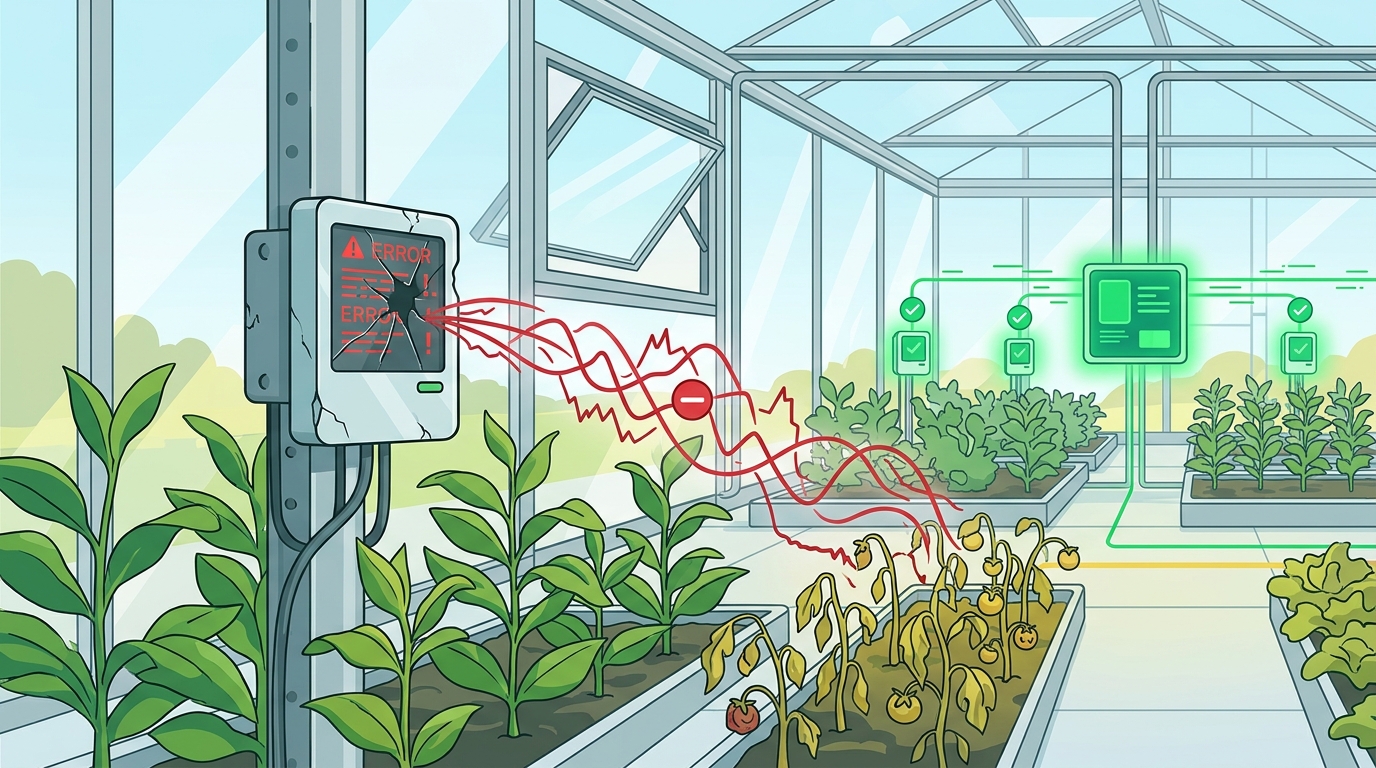
Yes, indirectly. Sensors do not usually damage crops on their own, but inaccurate readings or poorly designed control responses can create environmental conditions that interfere with plant growth. A temperature sensor exposed to direct sunlight may report a temperature higher than the surrounding air temperature. If a controller interprets that reading as representative of the entire greenhouse, it may activate cooling equipment too early or too aggressively.
The same principle applies to relative humidity, substrate moisture, carbon dioxide concentration, and other monitored variables. A system can respond consistently to its inputs while producing an unsuitable environment because those inputs do not accurately represent the crop zone.
The first diagnostic question is therefore not simply whether the equipment is operating. It is whether the measurements and control decisions accurately reflect the conditions that matter to the plants.
- When readings disagree with visible crop conditions: verify sensor location, calibration, and data quality before changing climate targets.
- When readings are reliable but conditions remain unsuitable: examine control logic, equipment capacity, and interactions among environmental variables.
- When both measurements and crop responses appear normal: avoid unnecessary adjustments and continue monitoring for meaningful changes.
This distinction matters because replacing a functional sensor will not correct a poorly designed control strategy, and rewriting a control strategy will not fix a sensor that consistently measures the wrong microclimate.
Why Does Sensor Placement Matter More Than Many Growers Expect?
A greenhouse is not a uniform chamber. Temperature, humidity, light exposure, and airflow can vary between the floor and the roof, near an exterior wall and in the center of a growing area, or between a ventilation inlet and a densely planted canopy.
A sensor records conditions at its own location. It does not automatically describe the environment throughout the structure.
Measuring the wrong part of the greenhouse
Consider a temperature sensor mounted close to a sun-heated roof panel. During a bright afternoon, it may experience warmer conditions than the leaves of the crop below. If the controller uses that reading to operate exhaust fans, the system may increase ventilation even when the main growing zone does not require the same level of cooling.
The opposite problem can occur when a sensor is positioned near a cool exterior wall or directly in the path of incoming air. Its readings may underestimate temperatures in warmer sections of the greenhouse, delaying cooling or heating responses where they are needed.
Use crop-relevant measurement locations
Place primary environmental sensors where their measurements represent the plants and the control objective. For many crops, that means positioning temperature and humidity sensors near the active canopy rather than automatically mounting every sensor at a convenient height.
As plants grow, the relevant measurement zone changes. A sensor that was appropriately positioned above young seedlings may sit below the canopy or in an unrepresentative airflow pocket after the crop becomes taller.
In larger or compartmentalized greenhouses, additional monitoring points can reveal differences that a single sensor conceals. If one section receives stronger sunlight or has weaker air circulation, a representative sensor in another section may not capture the local problem.
However, adding sensors indiscriminately is not always the answer. If several sensors are installed close together without a clear diagnostic purpose, they may provide redundant information while leaving the actual problem areas unmeasured. A better approach is to identify distinct climate zones and determine which measurements are necessary to characterize each one.
Are Your Temperature and Humidity Readings Trustworthy?
Even a well-positioned sensor can produce misleading information when it drifts out of calibration, becomes contaminated, responds too slowly, or operates outside its intended environmental range. These problems can remain hidden because a controller may continue displaying plausible numbers.
Calibration drift and sensor aging
Temperature and humidity sensors can gradually lose accuracy. Condensation, dust, chemical exposure, and repeated environmental stress may also affect performance, depending on the sensor design.
Compare suspect readings with a suitable reference instrument under comparable conditions. Follow the manufacturer's calibration procedure and account for the reference instrument's own uncertainty. If a sensor fails verification, correct or replace it according to the manufacturer's guidance rather than applying an arbitrary offset.
Calibration and verification are related but different. Calibration establishes the relationship between a measurement and a reference under defined conditions. Verification checks whether the instrument continues to perform within an acceptable tolerance. Routine verification helps identify developing problems before they cause persistent control errors.
Why relative humidity needs careful interpretation
Relative humidity describes how close the air is to saturation at its current temperature. It is not a direct measurement of the amount of water vapor in the air independent of temperature.
This distinction matters when greenhouse temperatures change quickly. Heating air can lower its relative humidity without removing water vapor, while cooling air can raise relative humidity without adding moisture. A controller that interprets every humidity change as a direct change in moisture content may respond inappropriately.
Leaf temperature also matters. Air conditions that appear acceptable at a sensor may still permit condensation on cooler plant surfaces. For crops sensitive to fungal disease, this gap between air measurements and leaf conditions can be particularly important.
If condensation risk is a concern, evaluate temperature, humidity, airflow, and the possibility of leaf surfaces approaching the dew point together. A relative humidity reading alone cannot fully characterize that risk.
Do not confuse a stable display with an accurate measurement
A reading that changes very little may indicate a stable environment, but it can also indicate a failed sensor, a communication problem, or a value that has become frozen in the controller. Conversely, short-lived fluctuations do not necessarily mean that a sensor is defective.
Review the measurement history and compare it with expected environmental changes. When ventilation starts, sunlight changes, or heating activates, the readings should respond in a manner consistent with the sensor's location and response time. A value that remains unchanged during an event that should affect it deserves investigation.
Which Common Control Mistakes Turn Good Data Into Bad Decisions?
Reliable measurements are only the first part of automated climate management. The controller must interpret them using rules that account for crop needs, equipment behavior, environmental interactions, and the limitations of the monitoring system.
1. Setting targets without considering crop development
Temperature and humidity targets should reflect the crop species, growth stage, production objective, and operating conditions. A setting suitable for one crop may be unsuitable for another, and a target that works during vegetative growth may require adjustment during flowering or fruit development.
Copying a generic climate schedule without checking whether it fits the crop can create persistent stress even when sensors are accurate.
What to do: establish crop-specific operating ranges, document the reasons for each setpoint, and adjust them only when crop requirements or production conditions justify the change. If the crop's requirements are uncertain, consult reliable crop-production guidance instead of assuming that a more aggressive target will improve growth.
2. Ignoring deadbands and excessive switching
A controller that activates cooling whenever temperature rises above a single threshold and stops it as soon as temperature falls below that threshold may switch equipment on and off repeatedly. Similar behavior can occur in heating, humidity control, and irrigation systems.
Frequent switching can increase wear, waste energy, and create unstable environmental conditions. A deadband or hysteresis allows the activation and deactivation thresholds to differ, reducing unnecessary cycling.
For example, a cooling system might activate above one temperature threshold and deactivate after the temperature falls sufficiently below it. The actual thresholds must be chosen according to crop needs, equipment characteristics, and the system's response time.
Wider deadbands are not universally better. If the permitted temperature range is too broad, the crop may experience undesirable fluctuations. The goal is stable control within an appropriate operating range, not simply minimizing equipment starts.
3. Using excessive filtering or reacting to every fluctuation
Environmental measurements contain natural variability. Airflow, sunlight, and equipment cycling can create short-term changes that do not require an immediate response. Filtering can help prevent the controller from reacting to every minor fluctuation.
However, excessive filtering or long averaging periods can delay the detection of a genuine problem. A rapid temperature rise may be smoothed out until the crop has already experienced an extended period of heat stress.
If the greenhouse experiences frequent harmless fluctuations, consider modest filtering and an appropriate deadband. If rapid environmental changes pose a meaningful crop risk, prioritize faster detection and a control strategy designed for that risk. Filtering should be matched to the process rather than selected simply to make graphs look smoother.
4. Controlling ventilation and humidity as unrelated problems
Ventilation can reduce indoor humidity under some conditions, but its effect depends on outdoor temperature, outdoor moisture content, and the conditions inside the greenhouse. Bringing in humid outside air may provide little drying benefit. In other circumstances, ventilation can remove heat that the heating system then has to replace.
Heating, ventilation, cooling, dehumidification, and air circulation therefore need coordinated logic. A humidity controller that repeatedly activates ventilation while a temperature controller immediately activates heating may cause both systems to work against each other.
Before changing setpoints, examine which devices activate at the same time and whether their combined effects support the desired climate. If outside conditions make ventilation ineffective for moisture removal, consider whether another available strategy is more appropriate for the greenhouse and crop.
5. Assuming every sensor value is valid
Automation can turn a single faulty reading into a sustained control error. A sensor reporting an implausibly low temperature might trigger heating, while a faulty humidity reading might lead to unnecessary ventilation or dehumidification.
Control systems should include reasonable validity checks, communication-loss detection, and appropriate responses to failed measurements. Where equipment and controller capabilities permit, compare related measurements and flag values that fall outside physically plausible or operationally expected ranges.
Do not automatically treat every disagreement between sensors as proof that one is faulty. Two sensors in different microclimates can legitimately report different values. The system must distinguish expected spatial variation from instrument failure.
What Can a Greenhouse Climate Data Table Reveal?
Reviewing measurements alongside control actions helps reveal whether a problem originates in the environment, the sensor, or the automation rules. The following examples illustrate common diagnostic patterns. They are hypothetical scenarios, not measured results or universal operating thresholds.
The most useful evidence comes from connecting environmental measurements to equipment events and crop observations over time. A single snapshot may reveal little, while a sequence of readings can show whether a control action precedes an undesirable change.
How Should You Validate Data Before Changing the System?
When crop performance declines, it is tempting to modify several climate settings at once. That approach can make the problem harder to diagnose because the effects of individual changes become difficult to separate.
A more disciplined process begins by identifying the specific symptom. Is the crop experiencing excessive heat, persistently high humidity, uneven growth between greenhouse zones, or repeated equipment cycling? Each symptom suggests a different set of measurements and control behaviors to investigate.
Compare independent measurements
Use a suitable reference instrument to check suspect sensors under comparable conditions. Allow instruments sufficient time to stabilize, account for their specified accuracy, and avoid comparing measurements taken in different airflow or radiation environments.
If readings agree within their expected uncertainty, investigate control settings and other environmental factors before assuming that calibration is the cause. If they disagree consistently, inspect the instruments, their installation, and their calibration status.
Check timestamps and communication quality
Data can be numerically plausible but operationally misleading when it is delayed, duplicated, or disconnected from its correct timestamp. A controller using an old reading may respond to conditions that no longer exist.
Review communication status, update intervals, missing records, time synchronization, and any fallback behavior activated during network interruptions. Confirm that the controller is using the intended sensor rather than a stale or incorrectly assigned data point.
Change one logical factor at a time
Once measurement quality is established, modify a specific control parameter or rule and monitor the resulting behavior. Record the original setting, the reason for the adjustment, the expected outcome, and the observed response.
For example, if unnecessary fan cycling is the identified problem, investigate the relevant deadband and timing rules before simultaneously changing temperature targets, humidity thresholds, and ventilation schedules.
This method is not absolute. During an urgent crop-threatening event, immediate protective action may take priority over controlled experimentation. Safety interlocks and emergency operating procedures should always remain effective. The one-change-at-a-time approach is most useful during routine diagnosis, optimization, and post-event analysis.
How Can Sensors, Irrigation, and Climate Controls Work Together?
Environmental monitoring becomes more valuable when it is interpreted alongside other growing-system information. Temperature and humidity influence transpiration, while root-zone moisture, irrigation timing, nutrient availability, light exposure, and crop development affect how plants respond to the surrounding climate.
A greenhouse can therefore show acceptable air temperature and relative humidity while plants experience water stress. The root zone may be too dry, irrigation distribution may be uneven, or high radiation may increase water demand beyond what the current irrigation schedule supplies.
Likewise, increasing ventilation to reduce humidity can change transpiration and irrigation demand. Heating can change relative humidity and increase the amount of moisture that plants release into the air under certain conditions. These interactions mean that climate adjustments should be evaluated against the broader growing environment.
Use complementary measurements rather than one universal indicator
Temperature and humidity sensors help characterize the air. Substrate moisture sensors provide information about the root zone. Light measurements help characterize the energy available to plants, while carbon dioxide monitoring can help growers understand whether ventilation and enrichment strategies are aligned with production objectives.
These measurements answer different questions and should not be treated as interchangeable. A substrate moisture sensor cannot establish whether the air is too humid, and an air temperature reading cannot establish whether roots have adequate water.
If climate readings appear normal but plant growth remains uneven, expand the investigation to irrigation uniformity, root-zone conditions, light distribution, nutrient management, and potential pest or disease pressure. If those factors appear satisfactory, revisit local climate differences and the timing of automated responses.
For hydroponic operations, include relevant solution and root-zone measurements in the diagnostic process. Electrical conductivity, pH, solution temperature, and delivery consistency may help explain crop symptoms that cannot be accounted for by air climate alone.
What Should You Check During a Routine Climate-Control Audit?
A practical audit should cover the complete chain from physical measurement to control action and crop response. It does not need to begin with new equipment. Existing sensor maps, controller settings, event histories, and maintenance records can reveal many problems.
- Sensor placement: Confirm that temperature and humidity sensors represent the crop zone and that direct sunlight, heating outlets, ventilation inlets, and other localized influences are understood.
- Sensor condition: Inspect for dust, condensation, corrosion, damaged cables, obstructed sensor housings, and other issues relevant to the instrument design.
- Calibration and verification: Check calibration records, reference comparisons, acceptable tolerances, and maintenance intervals.
- Data integrity: Review timestamps, missing measurements, frozen values, communication failures, and sensor-to-controller assignments.
- Control settings: Verify crop-specific targets, deadbands, timing rules, minimum equipment run times where applicable, and conflicting activation conditions.
- Environmental interactions: Examine whether heating, ventilation, cooling, dehumidification, and irrigation actions reinforce or undermine one another.
- Spatial differences: Compare conditions across distinct greenhouse zones rather than relying exclusively on a single central reading.
- Crop response: Record visible stress, uneven development, condensation, and other observations alongside environmental and equipment data.
- Failure handling: Confirm that alarms, fallback modes, manual overrides, and emergency procedures behave as intended.
- Change documentation: Record adjustments and compare outcomes over an appropriate observation period.
Prioritize checks according to the risk to the crop and the evidence available. A sensor reporting impossible values deserves immediate attention, while a small difference between two properly installed sensors may simply reflect real spatial variation.
Warning: Do not disable protective controls to make the climate graph look better.
Never bypass essential high-temperature protection, equipment safety interlocks, or other safeguards merely to stop repeated alarms or cycling. Before changing control limits, establish whether the sensor, actuator, control rule, or greenhouse environment is responsible. If a sensor fails, use a documented safe fallback procedure appropriate to the equipment and crop. Verify the replacement measurement and confirm that protective functions remain operational before returning to normal automatic control.
When Is More Automation Helpful, and When Is It Counterproductive?
Additional automation can improve consistency when the measurements are reliable, the crop requirements are understood, and the controller can coordinate the relevant equipment. It can also increase complexity when new sensors are added without a defined purpose or when more control rules introduce conflicting responses.
For a small greenhouse with a relatively uniform crop and stable environmental conditions, a limited set of well-maintained sensors may provide more useful control than an elaborate network with poorly documented settings.
For a large commercial greenhouse containing multiple crop varieties, climate compartments, or substantial spatial variation, additional sensors and zone-specific strategies may be justified. The important requirement is that each measurement has a clear role and that the control system can interpret it appropriately.
There is also a trade-off between rapid responsiveness and operational stability. Fast control may be necessary during dangerous temperature changes, but reacting to every small fluctuation can cause unnecessary equipment cycling. The right response depends on the crop's sensitivity, the greenhouse's thermal behavior, the capabilities of the equipment, and the reliability of the available measurements.
Growers should also recognize that not every yield problem is a climate-control problem. Poor germination, nutrient imbalances, pests, disease, pollination difficulties, and irrigation failures can all reduce production. Climate automation should be evaluated as one part of an integrated production system rather than as a universal remedy.
Frequently Asked Questions About Automated Greenhouse Climate Control
How often should greenhouse climate sensors be calibrated?
There is no single interval that suits every sensor and growing environment. Follow the manufacturer's guidance and consider the instrument's specified accuracy, environmental exposure, operating history, and the consequences of an incorrect reading. High-risk applications or sensors exposed to condensation and contamination may warrant more frequent verification. Calibration should also be considered after physical damage, unusual readings, or maintenance that could affect measurement accuracy.
Can one temperature and humidity sensor control an entire greenhouse?
It may be sufficient in a small, relatively uniform growing space, provided its location represents the crop and its measurements are reliable. In larger greenhouses or structures with substantial differences in sunlight, airflow, crop density, or equipment operation, multiple measurement points may be necessary. The decision should depend on demonstrated spatial variation and the control objectives rather than greenhouse size alone.
Why does my greenhouse controller show acceptable humidity when plants still develop disease symptoms?
Relative humidity is only one part of the picture. Cooler leaves, poor local airflow, condensation, prolonged periods of moisture on plant surfaces, and crop susceptibility can contribute to disease risk even when the main air sensor reports an acceptable value. Check local conditions and leaf wetness or condensation risk where relevant, and assess disease symptoms independently rather than assuming that a single humidity reading rules out a climate-related problem.
Should I lower the humidity target if condensation appears?
Not automatically. First determine whether condensation is related to low leaf temperature, insufficient air circulation, moisture entering the greenhouse, or ineffective humidity control. If air moisture is excessive, an appropriate dehumidification or ventilation strategy may help, depending on outside conditions and equipment capabilities. If leaves are cooling below the dew point, improving temperature distribution or airflow may be necessary as well. A lower target can help in some circumstances, but it is not a universal fix.
What should I do if two sensors show different temperatures?
Check their locations, installation conditions, specifications, and calibration records before deciding that either is faulty. Differences may be expected when one sensor is closer to sunlight, an exterior wall, a ventilation inlet, or a heat source. Compare them with a suitable reference instrument in comparable conditions. If the difference exceeds the instruments' expected uncertainty after location effects are considered, investigate calibration, damage, and data handling.
Can automated climate control improve yields without adding more sensors?
Yes. Correcting sensor placement, restoring calibration, improving control logic, and coordinating existing equipment can improve climate consistency without expanding the monitoring network. Additional sensors are useful when they address an identified information gap, such as an unmonitored greenhouse zone. They offer less value when the primary problem is a poorly configured controller or unreliable maintenance practices.
How can I tell whether a climate adjustment actually improved crop performance?
Define the intended outcome before changing the system. Track relevant environmental conditions, equipment behavior, and crop indicators over a suitable period, while accounting for growth stage, light, irrigation, and other changing conditions. Compare equivalent zones or production periods when feasible, and avoid attributing a yield change to a single adjustment without considering other plausible causes. Environmental stability can improve before a measurable yield effect becomes apparent.
Should a greenhouse controller always respond immediately to a sensor reading?
No. The response should depend on the variable, the reliability of the measurement, the severity of the deviation, and the time available before crop damage becomes likely. Minor fluctuations may justify filtering or a deadband, whereas a verified dangerous temperature excursion may require immediate protective action. Good control logic distinguishes routine variation from urgent conditions and preserves appropriate safety functions.
What Does Reliable Greenhouse Climate Automation Ultimately Require?
Automated greenhouse climate control improves crop production only when its measurements and decisions correspond to the conditions plants actually experience. Accurate sensors cannot compensate for conflicting control rules, and sophisticated controllers cannot reliably correct environmental problems when their input data is unrepresentative or outdated.
The most effective improvement process begins with evidence. Confirm sensor placement and measurement quality, examine data histories, review how equipment responds, and connect climate observations with irrigation, root-zone conditions, and crop development. Make targeted adjustments, document the results, and preserve protective controls throughout the process.
Most importantly, distinguish between a measurement problem and a genuine environmental problem. If the readings are unreliable, correct the measurement chain. If the readings are sound but equipment behavior is counterproductive, improve the control logic. If both are working as intended yet crops continue to struggle, investigate the wider production system instead of repeatedly changing climate targets.
This evidence-based approach turns environmental monitoring from a collection of displayed numbers into a practical decision-making tool. The goal is not to automate every possible action or eliminate every fluctuation. It is to maintain crop-appropriate conditions with dependable measurements, coordinated equipment, and a clear understanding of when the system should act, when it should wait, and when a human inspection is needed.
Practical action checklist
- Review the criteria in Can Greenhouse Sensors Really Reduce Crop Yields? before applying the guidance to your situation.
- Review the criteria in Why Does Sensor Placement Matter More Than Many Growers Expect? before applying the guidance to your situation.
- Review the criteria in Measuring the wrong part of the greenhouse before applying the guidance to your situation.
- Review the criteria in Use crop-relevant measurement locations before applying the guidance to your situation.


Comments
Post a Comment