Beyond Temperature: What Humidity and CO2 Secrets Drive Peak Hydroponic Yields?
What actually limits a high-performing hydroponic crop when temperature already looks right? In many controlled environments, the overlooked answer is not another degree on the thermostat. It is the relationship among humidity, vapor pressure deficit (VPD), carbon dioxide, airflow, light, and temperature. That is the core idea behind Hydroponic Climate Optimization: a crop responds to a climate system, not to a collection of independent dashboard numbers.
The distinction matters because a greenhouse can display an apparently comfortable temperature while the leaves experience excessive evaporative demand, poor air exchange, condensation risk, or daytime carbon dioxide depletion. Conversely, lowering humidity aggressively or adding CO2 simply because a higher concentration is associated with faster photosynthesis can create a different problem: unnecessary energy use, ventilation losses, poor control stability, or an unsafe occupied environment.
Is temperature really the main climate variable?
Short answer: no. Temperature is important because it influences biochemical reaction rates, transpiration, saturation vapor pressure, and the amount of moisture air can hold. But it is only one part of the environment surrounding the leaf. Relative humidity changes with temperature, so the same RH percentage can represent very different atmospheric conditions at different temperatures.
That is why a climate controller that asks only, “Is the room 75°F?” is asking an incomplete question. The more useful question is, “What is the plant experiencing at the canopy, and how is that condition changing over the photoperiod?”
University of Massachusetts greenhouse guidance makes the same conceptual point: humidity is strongly temperature-dependent, condensation occurs when plant surfaces reach the dew point, and ventilation, heating, irrigation timing, and air movement can all affect moisture conditions. In other words, greenhouse humidity is a temperature problem too, but temperature does not explain the entire humidity problem.
What does humidity actually tell the plant?
Relative humidity, or RH, describes how close air is to saturation at a particular temperature. It is useful, but it is not a direct measurement of how strongly the atmosphere is pulling water from a leaf.
VPD, or vapor pressure deficit, provides a more plant-centered way to interpret temperature and humidity together. It describes the difference between the moisture the air could hold at saturation and the moisture actually present. When VPD rises, the atmospheric demand for water generally rises as well. When VPD falls toward saturation, evaporative demand declines.
This is why two rooms can both read 70% RH yet produce different plant responses if their temperatures differ. A crop does not encounter “70%” in isolation. Its leaves encounter a particular combination of temperature and water vapor pressure.
A useful mental model is:
Temperature + RH → vapor pressure conditions → VPD → transpiration demand
That chain also explains why humidity management should not be reduced to “keep RH below a certain number.” A fixed RH ceiling can be sensible as a disease-prevention safeguard in one operating range and unnecessarily dry in another.
Why does VPD reveal problems that RH can hide?
Consider two simplified situations. In the first, the air is relatively warm and the RH is moderate. In the second, the RH percentage is identical but the air is substantially cooler. The percentage is unchanged, but the vapor-pressure relationship is not. The crop's evaporative environment has therefore changed.
This creates an important misconception correction: RH is not useless, but RH alone is an incomplete control variable. VPD is useful because it puts temperature and moisture into the same physiological context.
There is also a second layer: the leaf itself may be warmer or cooler than the surrounding air. Radiant loads, air movement, lighting, and transpiration can all contribute to leaf-to-air differences. A room sensor mounted in a convenient location therefore cannot automatically be assumed to represent the microclimate immediately around every leaf.
For a greenhouse operator, the practical implication is conditional rather than absolute. If canopy conditions are stable and the crop response is predictable, a simple RH-and-temperature strategy may be adequate; if crop stress, condensation, or irrigation behavior changes without an obvious temperature explanation, VPD and canopy-level measurements deserve more attention.
Why can humidity be too high even when plants are well watered?
Hydroponics removes soil from the root-zone equation, but it does not remove water from the greenhouse atmosphere. Plants transpire, wet surfaces evaporate, nutrient solution can contribute moisture, and humid air can accumulate around dense foliage.
The canopy can therefore become a separate microclimate. The air immediately surrounding leaves may be more humid and less mixed than the air measured in an open aisle. This is especially important at night, when temperatures fall and air approaches the dew point.
Condensation is a particularly useful warning signal. If a leaf surface falls below the dew point, water can condense on it even when the controller's average room RH does not look extraordinary. Once free water remains on foliage, the disease environment can become much more favorable.
University of Massachusetts guidance emphasizes keeping the plant canopy dry, using appropriate irrigation timing, maintaining air movement, and using ventilation and heating together when necessary. This does not mean “heat everything” or “vent constantly.” It means moisture removal should be coordinated with the thermal condition of the greenhouse.
Does higher humidity always improve water efficiency?
No. This is one of the most useful counterexamples in climate control. Reducing evaporative demand can reduce transpiration and water loss, but an overly humid environment can also suppress desirable transpiration, increase condensation risk, and create conditions favorable to disease.
The opposite extreme has its own trade-off. Very dry air can increase evaporative demand, forcing the crop to move water rapidly through its tissues. Depending on crop, stage, root-zone supply, leaf temperature, and light load, that can increase stress even when the nutrient solution is abundant.
So the goal is not the lowest possible VPD or the highest possible RH. The goal is a physiologically appropriate range that fits the crop, growth stage, light environment, irrigation strategy, and disease risk.
This is where conditional control is more useful than universal rules:
- If the crop is losing water too quickly and irrigation cannot keep pace, consider whether evaporative demand is excessive before simply increasing irrigation.
- If leaves remain wet or condensation repeatedly appears, reducing moisture load and improving canopy air movement may matter more than lowering the temperature.
- If RH appears acceptable but the crop behaves inconsistently across zones, investigate spatial differences rather than changing the whole-room setpoint immediately.
Where does CO2 enter the equation?
Carbon dioxide is not merely another number beside temperature and humidity. It is a raw material for photosynthesis, so its usefulness depends on whether the crop has enough light and the physiological capacity to assimilate the additional carbon.
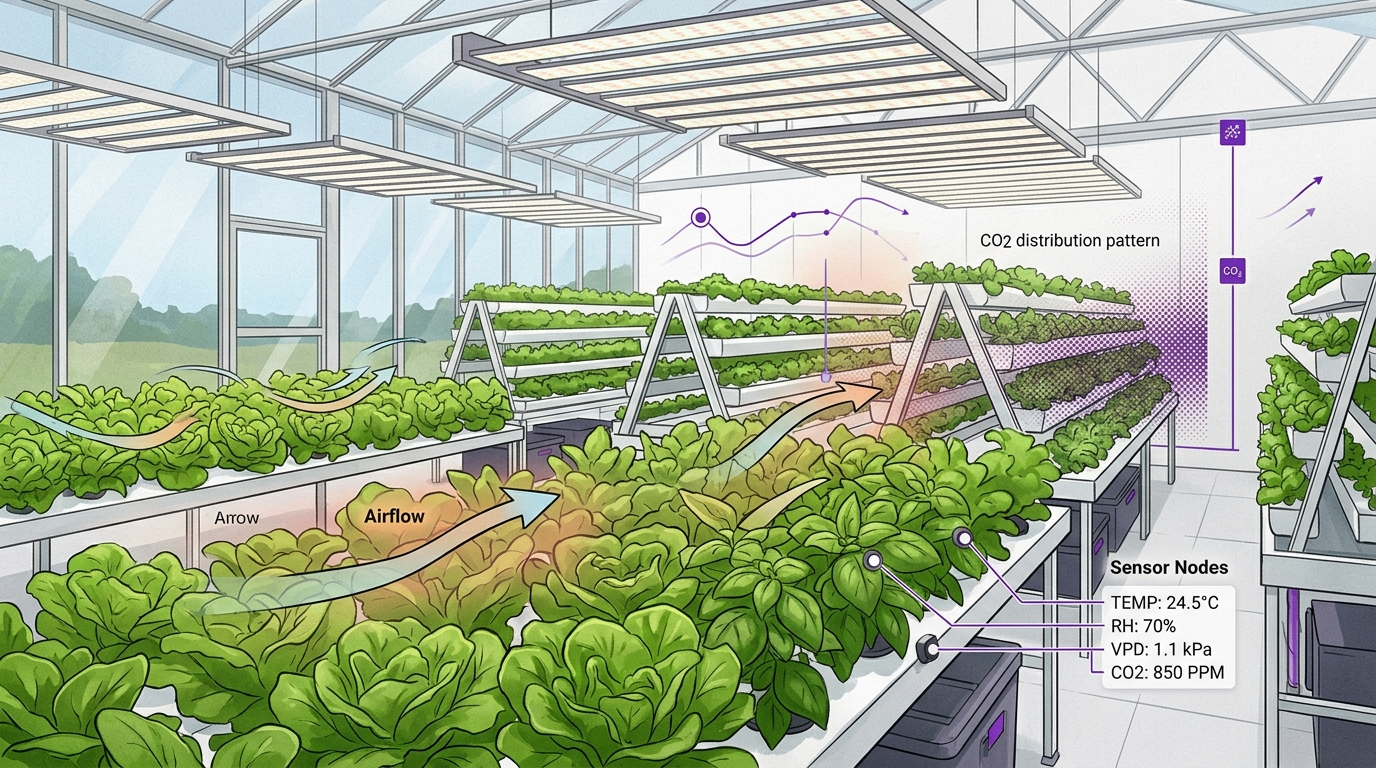
In an enclosed growing environment, the crop itself can become the reason daytime CO2 falls. Photosynthesis removes CO2 from the air around the leaves. If ventilation is limited and replenishment is insufficient, the concentration can fall substantially during the light period.
Research reviewed in Frontiers in Plant Science describes this daytime depletion as a recurring limitation in greenhouse production. The same review also emphasizes that CO2 efficiency is affected by ventilation, leakage, crop uptake, spatial distribution, and timing. Thus, daytime CO2 can become the hidden bottleneck even when temperature and humidity appear well controlled.
Does adding more CO2 always mean more yield?
Not automatically. Elevated CO2 can increase photosynthesis and, in appropriate circumstances, biomass and yield. But the response is conditional. If light is limiting, nutrient availability is inadequate, temperature is unsuitable, or the crop cannot use the additional carbon efficiently, the value of enrichment can fall.
A 2026 meta-analysis of 73 cucumber studies found significant increases in photosynthesis, water-use efficiency, biomass, and yield under elevated CO2, while also emphasizing interactions with light, temperature, humidity, and fertilizer. The paper's most important lesson for climate control is therefore not a single universal ppm number. It is that CO2 works as part of a climate system.
The same reasoning creates a useful counterexample. Imagine a sealed room where CO2 is increased but ventilation, light, and canopy mixing are poorly managed. A central sensor may show a desirable concentration while portions of the crop receive less. Alternatively, enrichment may be lost rapidly when ventilation opens for cooling or moisture control.
That is why “increase CO2” is not a complete control strategy. The better question is whether the crop is actually CO2-limited during productive light periods and whether the facility can retain and distribute the added gas efficiently.
Why does airflow matter to both humidity and CO2?
Air movement is often treated as a comfort or temperature-uniformity issue. Around a crop canopy, it is much more consequential.
A leaf modifies the air immediately around itself. Transpiration adds water vapor, while photosynthesis consumes CO2. If the air adjacent to the leaf is not sufficiently mixed, the resulting boundary layer can differ from the room average. Moving air can reduce these gradients and make the surrounding atmosphere more representative of the intended climate.
University greenhouse guidance describes horizontal airflow as a way to improve temperature uniformity, move moisture away from plant surfaces, and improve CO2 delivery to plants. That makes airflow an enabling variable: it helps the other environmental controls reach the crop rather than merely changing the room average.
But airflow has an exception. More fan speed is not automatically better. Excessive air movement can increase evaporative demand, create localized drying, increase energy consumption, or interact poorly with sensitive plants. The useful target is adequate mixing and canopy exchange, not maximum wind.
What should greenhouse sensors actually measure?
A climate-control system is only as good as the measurements driving it. This sounds obvious, but sensor placement can quietly undermine an otherwise sophisticated automation strategy.
Temperature and humidity data should be read together. If they are measured at different locations, at different times, or with significantly different exposure to radiant heat, the calculated VPD may describe a condition that does not actually exist around the crop.
The same issue applies to CO2. CO2 should be measured where the crop actually breathes, while still protecting the sensor from direct contact with irrigation spray, extreme local conditions, and mechanical damage. A single ceiling-mounted reading may not reveal a canopy-level distribution problem.
Radiation is another hidden source of error. A sensor exposed to direct light can warm relative to the surrounding air, producing a biased temperature reading. That is why protect the sensor from direct radiation is not merely a hardware-care instruction; it is a climate-control requirement.
Measurement quality also requires maintenance. NIST's humidity-metrology work describes controlled calibration of relative-humidity sensors and shows why humidity measurements depend on defined temperature and moisture conditions. In practical terms, sensor accuracy is part of climate optimization. A controller cannot compensate intelligently for a drifting measurement.
Can one sensor represent an entire hydroponic room?
Sometimes, but only when the room is genuinely uniform enough for that assumption.
Consider a compact leafy-greens room with strong circulation and a modest canopy. One well-positioned measurement point may provide a useful control signal. Now consider a large greenhouse divided by crop rows, lighting zones, height differences, doors, vents, and dense foliage. A single point becomes much less persuasive.
This leads to an important decision rule: if measurements from several representative crop zones move together, a centralized strategy may be reasonable; if they diverge consistently, zoning or additional measurement becomes more valuable than endlessly adjusting the average setpoint.
There is no universal sensor count that guarantees good control. The right number depends on spatial variability, crop height, air movement, greenhouse geometry, light distribution, ventilation pattern, and the consequences of a control error.
How should temperature, humidity, VPD, and CO2 be interpreted together?
The most useful way to think about the system is as a chain of interacting constraints rather than four independent targets.
The table exposes the central principle: a number becomes useful when its biological meaning is understood. A CO2 reading without light context is incomplete. RH without temperature is incomplete. Temperature without canopy location is incomplete. VPD without crop context is incomplete.
What is the practical climate-optimization workflow?
A useful workflow begins with observation rather than setpoint hunting. Before changing a target, establish what the crop is experiencing and when the problem appears.
Practical action checklist
- Check temperature and RH at representative crop height rather than relying automatically on a wall or ceiling location.
- Interpret RH alongside temperature and, where useful, calculate VPD.
- Look for nighttime condensation or repeated high-humidity periods rather than focusing only on daytime averages.
- Compare canopy conditions with open-room conditions to identify microclimates.
- Review CO2 trends across the light period to determine whether photosynthetic demand is depleting the local concentration.
- Check whether ventilation events coincide with rapid CO2 losses.
- Inspect airflow patterns when humidity or CO2 differs substantially between crop zones.
- Verify sensor placement, shielding, cleanliness, calibration status, and consistency before changing automation logic.
- Use time-series data to distinguish recurring patterns from one-off disturbances.
- Change one major control variable at a time when possible, then observe the crop response before making another large adjustment.
This sequence prevents a common failure mode: using automation to amplify an incorrect measurement. Calibration turns a number into usable evidence. If the measurement is wrong, faster automation simply produces wrong decisions faster.
What does a climate-control system look like when the variables are connected?
Imagine a bright greenhouse during the morning. Light rises, photosynthesis accelerates, and CO2 consumption increases. At the same time, transpiration adds moisture to the air. If ventilation remains closed, CO2 can decline while humidity rises. If the controller reacts only to temperature, it may do nothing because the temperature remains inside its target range.
Now consider the same greenhouse with adequate airflow. Moisture is mixed away from leaf surfaces, CO2 is distributed more evenly, and temperature differences shrink. The control system has not necessarily changed its temperature target at all, but the crop's effective environment has improved.
Later, outside air conditions may force ventilation. CO2 enrichment becomes less efficient because some of the added gas leaves with the exhausted air. If humidity control requires ventilation, the system must balance two objectives rather than pretending that each variable can be optimized independently.
This is why advanced greenhouse control is better understood as a constrained optimization problem. Improving one variable can impose a cost on another. Lowering humidity through ventilation may lose CO2. Adding CO2 in a leaky environment may increase waste. Increasing airflow can improve mixing while increasing transpiration. Raising temperature can alter RH and VPD even when the absolute moisture content has barely changed.
When should a grower not chase a tighter climate target?
Precision is valuable, but precision is not the same as constant adjustment.
If a crop is performing consistently, measurements are trustworthy, and environmental variation stays within a biologically acceptable range, repeatedly changing setpoints can create more instability than benefit. A controller that reacts aggressively to every small fluctuation may cause oscillation: heating, cooling, humidifying, dehumidifying, ventilating, and enriching in rapid succession.
The better approach is conditional. If the crop response is stable and the measurements are reliable, prioritize stability; if a repeatable physiological or disease-related problem tracks a climate variable, investigate that relationship before tightening the control target.
There is also a scale issue. The precision justified in a research chamber is not necessarily justified in a large commercial greenhouse. A highly granular control strategy may require more sensors, maintenance, actuators, and energy. The additional complexity is worthwhile only when it produces a meaningful improvement in crop consistency, resource efficiency, risk reduction, or yield.
Warning: crop CO2 targets are not human safety limits.
CO2 enrichment for plants must never be treated as a worker-exposure guideline. NIOSH and OSHA publish occupational exposure information for carbon dioxide, and concentrations that may be discussed in horticultural contexts are not permission to expose people to uncontrolled gas accumulation. Occupied greenhouses should have appropriate ventilation, monitoring, alarms, emergency procedures, and independent safety controls. A plant-growth controller should never be the only CO2 safeguard.
What are the most common climate-control misconceptions?
Misconception 1: “If temperature is correct, the climate is correct.”
Temperature can be correct while VPD, condensation risk, canopy humidity, or CO2 availability is unfavorable.
Misconception 2: “70% RH is always 70% RH to a plant.”
The physiological meaning of RH changes with temperature. That is why VPD is useful for interpretation.
Misconception 3: “More CO2 is always better.”
CO2 response depends on crop physiology and interactions with light, temperature, humidity, nutrients, ventilation, and acclimation.
Misconception 4: “One accurate sensor solves measurement.”
A sensor can be technically accurate and still be strategically misplaced. A measurement in the wrong microclimate can produce a misleading control signal.
Misconception 5: “More airflow is always healthier.”
Air movement is useful for mixing and drying leaf surfaces, but excessive movement can increase evaporative demand and energy consumption.
More questions about humidity, CO2, and hydroponic climate control
Is VPD better than relative humidity?
VPD is often more informative for plant-water relations because it incorporates temperature, while RH is still valuable for monitoring saturation and condensation risk. The two measurements answer related but different questions. A strong control system can use both rather than treating them as competitors.
Should every hydroponic system use CO2 enrichment?
No. Enrichment makes more sense when the crop is demonstrably CO2-limited during productive light periods and when the facility can use the additional CO2 effectively. If ventilation is frequently required or light is the primary limitation, enrichment may provide less benefit than expected.
Why can CO2 readings vary across the same greenhouse?
Plants consume CO2 near their leaves, while ventilation, buoyancy, air movement, room geometry, and injection location affect distribution. Dense canopies can therefore develop CO2 gradients that a single sensor does not reveal.
Does high humidity always cause plant disease?
No. Disease risk depends on the pathogen, crop, duration of wetness, temperature, airflow, plant condition, and other factors. High humidity becomes particularly concerning when it produces condensation or prolonged wet leaf surfaces. Humidity should therefore be treated as one component of disease management rather than a standalone diagnosis.
Why can RH rise at night even if no water is added?
Cooling air holds less water vapor at saturation. As temperature falls, the same absolute moisture content can correspond to a higher RH, eventually reaching the dew point. This is why nighttime climate control deserves separate attention rather than simply using daytime settings around the clock.
Can a greenhouse have good average conditions but poor plant-level conditions?
Yes. Dense foliage, insufficient circulation, radiant heating, cold surfaces, and local ventilation patterns can create microclimates. If crop performance differs by zone while room averages look normal, spatial measurement is worth investigating.
Should climate targets be identical for every crop?
No. Crop species, cultivar, growth stage, canopy density, light level, root-zone conditions, and production goals can change the appropriate balance. Research can identify useful ranges, but a universal setpoint should be treated skeptically.
What is the most important measurement to improve first?
There is no universal answer. If condensation and disease pressure dominate, humidity, dew point, canopy temperature, and airflow may deserve priority. If photosynthesis appears carbon-limited under strong light, CO2 measurement may be more revealing. If irrigation demand is unstable, temperature and humidity together can expose changing VPD. The correct first measurement is the one most closely connected to the observed problem.
So what really drives peak hydroponic yield?
The answer is not a secret temperature setting or a single ideal CO2 number. Peak performance emerges when the crop receives a coherent environment in which temperature, atmospheric moisture, CO2, light, airflow, irrigation, and nutrition support one another rather than compete.
The evidence points toward a more nuanced view of Hydroponic Climate Optimization. Humidity matters because it changes evaporative demand and condensation risk. VPD matters because it interprets humidity through temperature. CO2 matters because photosynthesis can deplete the local supply during productive periods. Airflow matters because the leaf experiences a microclimate, not an abstract room average. Sensors matter because every automated decision begins with a measurement.
The most valuable shift, then, is from asking “What should my temperature, RH, or CO2 setpoint be?” to asking “What is limiting the crop right now, where is that limitation occurring, and which measurements can prove it?” If the answer points to excessive evaporative demand, improve the moisture-temperature relationship. If condensation is recurring, focus on dew point, canopy wetness, and moisture removal. If daytime CO2 falls under strong light, investigate distribution and enrichment efficiency. If zones disagree, improve measurement and mixing before changing the whole room.
That approach avoids both extremes: treating climate control as a simple thermostat problem and treating every measurable variable as something that must be continuously optimized. The objective is not the most numbers on a dashboard. It is a stable, evidence-based environment in which the plant can convert light, water, carbon dioxide, and nutrients into useful growth with as little avoidable stress and resource waste as possible.
FAQ
What should I check first about Is temperature really the main climate variable??
Review the criteria, conditions, limits, and exceptions already explained in Is temperature really the main climate variable?, then apply the points that match your situation.
What should I check first about What does humidity actually tell the plant??
Review the criteria, conditions, limits, and exceptions already explained in What does humidity actually tell the plant?, then apply the points that match your situation.
What should I check first about Why does VPD reveal problems that RH can hide??
Review the criteria, conditions, limits, and exceptions already explained in Why does VPD reveal problems that RH can hide?, then apply the points that match your situation.
What should I check first about Why can humidity be too high even when plants are well watered??
Review the criteria, conditions, limits, and exceptions already explained in Why can humidity be too high even when plants are well watered?, then apply the points that match your situation.
What should I check first about Does higher humidity always improve water efficiency??
Review the criteria, conditions, limits, and exceptions already explained in Does higher humidity always improve water efficiency?, then apply the points that match your situation.
What should I check first about Where does CO2 enter the equation??
Review the criteria, conditions, limits, and exceptions already explained in Where does CO2 enter the equation?, then apply the points that match your situation.


Comments
Post a Comment