Why Your Hydroponic or Greenhouse Crops Struggle: Overlooked Light Spectrum Secrets for Maximum Yields
At a glance: Grow light spectrum optimization is not simply a matter of choosing more red, more blue, or a fixture labeled “full spectrum.” Plants respond to the combination of spectral composition, light intensity, photoperiod, daily light integral, canopy position, temperature, carbon dioxide, water, and nutrition. A spectrum that produces compact seedlings may not be the spectrum that supports the same crop during flowering or fruit filling.
- First priority: determine whether the crop is actually receiving enough usable light before trying to fine-tune wavelength ratios.
- Second priority: separate spectral effects from intensity, temperature, and photoperiod effects.
- Third priority: evaluate the plant response you actually want: biomass, compactness, leaf quality, flowering, fruit production, or a particular metabolite profile.
When hydroponic or greenhouse crops look healthy but still grow slowly, stretch unexpectedly, flower at the wrong pace, or produce less usable biomass than expected, light quality can be part of the explanation. Grow light spectrum optimization matters because light is not merely fuel for photosynthesis. Spectral signals also influence plant architecture, developmental timing, metabolism, and interactions with the surrounding environment. Recent research continues to show that light spectral composition affects plant biomass and development, but the response depends heavily on species, developmental stage, intensity, and growing conditions.
Why “more light” and “better spectrum” are different problems
Plants do not experience a grow light as a single number. They receive photons across wavelengths and over time. Photosynthetic photon flux density, or PPFD, describes the instantaneous photon flux in the photosynthetically relevant range, while daily light integral, or DLI, describes the accumulated quantity of photosynthetic photons received over a day.
That distinction creates an important diagnostic rule. If a crop is chronically light-limited, changing the spectral balance may produce a visible change without solving the underlying shortage. Conversely, if enough daily light is already reaching the crop, changing spectral composition can alter plant form or development without dramatically changing total photon delivery.
USDA research on hydroponic baby-leaf greens illustrates why this context matters. Researchers controlled DLI when comparing supplemental light sources, yet seasonal differences remained in crop responses. The work suggests that natural sunlight and environmental conditions can change how strongly plants respond to supplemental-light differences. r1
The practical implication is simple: measure the light environment before interpreting the plant's appearance as a spectrum problem.
The spectrum is a set of signals, not a color chart
Plants contain several light-sensitive systems. Chlorophylls absorb strongly in parts of the blue and red regions, while other photoreceptors respond to wavelengths that influence developmental signaling. That means two lighting environments can deliver similar total photosynthetic photon quantities while producing different plant shapes and developmental behavior.
Blue light is commonly associated with photoreceptor-mediated responses that can influence morphology, stomatal behavior, chlorophyll-related processes, and compactness. Red light is highly effective for photosynthesis and interacts strongly with phytochrome signaling. Green wavelengths are not simply “wasted”; they can penetrate deeper into a canopy and participate in photosynthesis and signaling. Far-red radiation can alter the balance of phytochrome states and influence shade-avoidance responses, including elongation and leaf-area changes.
This is why the simplistic claim that plants “only need red and blue” is incomplete. Peer-reviewed reviews find substantial responses to different spectral environments, while also emphasizing that outcomes vary by species and experimental conditions. r2
Key comparison: what different wavelength regions can influence
The table below is a conceptual comparison, not a universal recipe. Wavelength bands overlap, photoreceptor responses are interconnected, and the same spectral treatment can produce different outcomes in lettuce, tomato, basil, strawberry, ornamentals, or young transplants.
The overlooked variable: intensity changes the meaning of spectrum
A common mistake is to discuss spectral ratios as though a 10% change in one wavelength has a predictable biological effect regardless of intensity. It does not. The physiological result depends on how many photons actually reach the leaves and for how long.
Recent USDA research on supplemental LED lighting in controlled greenhouse conditions found that both light quality and intensity affected measured growth and physiological responses. In that work, blue and white light at higher intensities affected vegetative budbreak, while red, blue, and white combinations produced different shoot-growth responses; far-red also changed shoot elongation and leaf area when combined with other wavelengths. r3
This creates a useful decision rule: if changing the spectrum also changes PPFD substantially, do not attribute the plant response to spectrum alone. First ask whether the crop simply received more or less usable light.
Red and blue are useful, but the “red-blue only” idea has limits
Red and blue wavelengths have strong physiological importance, which explains why they have dominated many controlled-environment lighting experiments. But experimental success with red and blue does not mean every commercial crop should be exposed to a narrow two-color spectrum.
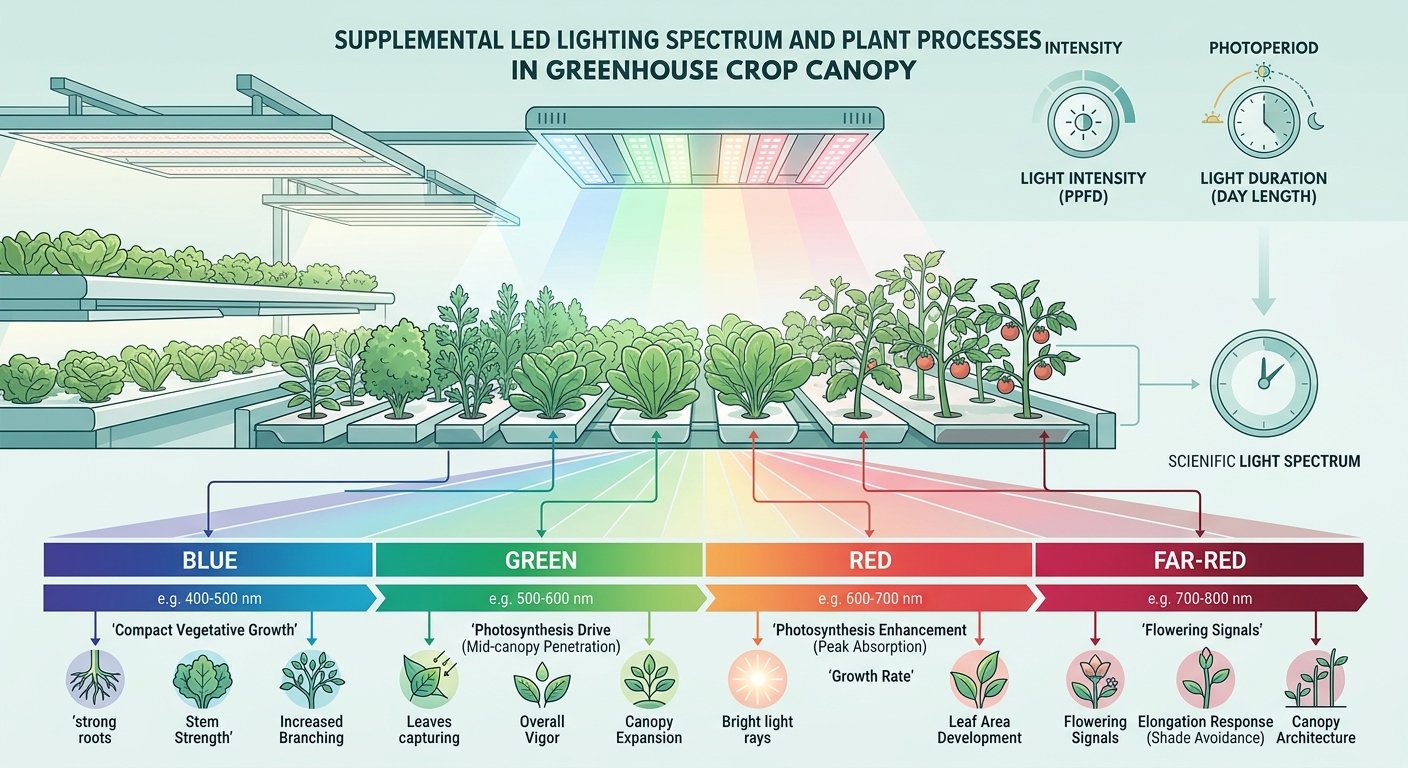
Plant canopies are three-dimensional. Upper leaves intercept incoming radiation, while lower leaves may receive a different spectral environment after light has passed through the canopy. Green and longer wavelengths can contribute to the light environment deeper within foliage. Meanwhile, the visual appearance of a lamp tells humans little about the exact photon distribution reaching individual leaves.
A quantitative review of LED research in protected cropping found that effects were not easily generalized because studies differed in species, varieties, measured traits, wavelength treatments, PPFD, and plant age. r4 That finding is especially important for commercial production: a result demonstrated in a young leafy crop should not automatically be transferred to a mature fruiting crop.
Far-red: powerful developmental signal, not a magic yield switch
Far-red is frequently discussed as a way to influence canopy expansion and flowering or fruiting behavior, but the biology is more nuanced. Plants use the red-to-far-red relationship as information about their light environment. In a dense canopy, neighboring leaves alter the spectrum reaching lower leaves, creating a signal associated with competition for light.
Adding far-red can therefore change plant architecture, often increasing elongation or leaf area under appropriate conditions. That can be beneficial when a grower wants faster canopy expansion, but it can be undesirable when compact plants, strong stems, or short internodes are priorities.
The key counterexample is important: more far-red does not automatically mean more harvestable biomass. USDA research has found that far-red responses depend on its combination with other wavelengths and can produce stronger shoot elongation rather than a simple increase in every desirable yield trait. r5
Why greenhouse crops behave differently from indoor crops
A greenhouse is not a sealed light laboratory. Sunlight changes by season, hour, weather, latitude, greenhouse orientation, glazing, shading screens, and canopy structure. A supplemental LED spectrum therefore interacts with a moving background spectrum rather than operating alone.
This explains why a spectral strategy that appears dramatic in a sole-source indoor system can have a smaller effect in a sunlit greenhouse. USDA work with hydroponic baby-leaf greens found seasonal differences between lighting treatments even when DLI was controlled, and the researchers suggested that natural light and leaf-temperature differences were important context. r6
For greenhouse production, the right question is often not “Which spectrum is best?” but “What spectral gap, if any, exists after sunlight and the greenhouse structure are considered?” That shift prevents unnecessary tuning based on an indoor-farm assumption.
Stage matters: seedlings, vegetative growth, flowering, and fruit filling
Plant development changes the meaning of a lighting intervention. Young transplants may benefit from an environment that encourages sturdy, compact growth. A rapidly expanding vegetative canopy has different priorities. A flowering or fruiting crop may require a different balance between carbon gain, architecture, reproductive development, and canopy penetration.
That does not mean every stage requires a completely different spectrum. Frequent spectrum changes can create their own complexity, and the evidence does not support a universal stage-by-stage recipe for all crops. Instead, think in terms of the dominant biological objective.
- If seedlings are excessively stretched: investigate insufficient light, photoperiod, plant density, temperature, and spectral signals before assuming a simple blue-light deficiency.
- If vegetative plants are too compact: determine whether compactness is actually limiting canopy interception before increasing wavelengths associated with elongation.
- If flowering is delayed: check photoperiod and crop-specific developmental requirements rather than treating flowering as a generic “more red” problem.
- If fruit yield is disappointing: examine total daily light, canopy distribution, temperature, carbon dioxide, nutrition, and sink development alongside spectrum.
What the crop tells you when spectrum is wrong
Plant appearance is useful evidence, but it is not a spectral diagnostic by itself. Stretching can arise from insufficient intensity, excessive density, high temperature, photoperiod effects, or spectral signaling. Pale leaves can indicate nutritional problems, root-zone problems, temperature stress, or inadequate light. Poor fruit set has an even longer list of possible causes.
The strongest diagnosis comes from combining visual observations with measurements. Record PPFD at representative canopy locations, calculate or estimate DLI, note photoperiod, record temperature and humidity, and document plant stage. Then compare the crop response before and after one controlled change.
This is more informative than changing several light settings at once. If spectrum, intensity, photoperiod, nutrient concentration, and temperature all change together, the resulting improvement cannot be assigned confidently to any one factor.
What to do now: a fast decision sequence
For growers trying to resolve a real crop-performance problem, the following sequence keeps spectrum in its proper place.
- Define the failed outcome. Is the problem low biomass, excessive stretch, delayed flowering, poor fruit filling, weak lower-canopy growth, or quality?
- Measure usable light. Use a PAR light meter, PPFD meter, or appropriate quantum sensor to determine what the crop actually receives rather than relying on lamp brightness.
- Estimate daily exposure. Look at DLI and photoperiod, not just a single midday reading.
- Check the background environment. In a greenhouse, include sunlight, glazing, shade cloth, season, and temperature. In hydroponic rooms, include canopy density and reflective surfaces.
- Change one major variable. If intensity is deficient, address intensity first. If quantity is already adequate and morphology remains problematic, spectral composition becomes a stronger candidate.
- Compare the same developmental stage. A treatment that changes seedlings may not produce the same result in mature plants.
- Track harvestable outcomes. Biomass, marketable fruit, leaf quality, flowering time, and resource efficiency matter more than an attractive change in leaf shape alone.
Practical action checklist
- ☐ Identify the crop, cultivar, and developmental stage.
- ☐ Measure canopy-level PPFD rather than judging brightness by eye.
- ☐ Record photoperiod and calculate or estimate DLI.
- ☐ Note greenhouse sunlight, season, glazing, and shade conditions.
- ☐ Check canopy temperature before interpreting morphology as a spectrum effect.
- ☐ Inspect lower-canopy light distribution, not only the top leaves.
- ☐ Change one major lighting variable at a time when testing a hypothesis.
- ☐ Compare results using harvestable yield and crop quality, not appearance alone.
Common misconceptions that waste time
“Full spectrum” automatically means optimal spectrum
Full-spectrum language can be useful shorthand, but it does not describe intensity, photon distribution, uniformity, photoperiod, or how the spectrum changes across the canopy. Two lights can both be described as broad spectrum while producing meaningfully different plant responses.
“Plants use red and blue, so green does nothing”
That conclusion is too narrow. Green light can penetrate plant canopies and contribute to photosynthesis and signaling. Its value is difficult to infer from human visual perception alone.
“More red always means more yield”
Red photons are highly useful for photosynthesis, but plant response depends on intensity, other wavelengths, developmental stage, and environment. USDA greenhouse research has even documented crop-specific differences in morphology and nutrient responses under supplemental lighting. r7
“Far-red is only for stretching”
Far-red is strongly involved in elongation and shade-response signaling, but its interactions with red and other wavelengths can affect leaf area and developmental outcomes. The useful question is whether those architectural changes improve the production goal.
“A spectrum that worked for lettuce will work for tomatoes”
Crop species and cultivars can respond differently. Peer-reviewed synthesis specifically identifies species, varieties, traits, plant age, PPFD, and growing environment as reasons LED responses cannot be generalized easily. r8
Warning: spectral tuning can create a false diagnosis
Do not assume a visible crop symptom proves a spectrum problem. Light intensity, root-zone conditions, temperature, humidity, nutrition, carbon dioxide, plant density, disease, and irrigation can produce overlapping symptoms. Excessive light in a narrow band can also cause injury; USDA research on greenhouse strawberries, for example, reported harmful effects associated with high-intensity red LED irradiation in some treatments. r9
Light quality also changes crop quality, not just growth rate
The goal of controlled-environment agriculture is not always maximum fresh mass. Spectral composition can influence pigments, phenolic compounds, flavonoids, antioxidants, and other secondary metabolites. That creates a trade-off: a lighting treatment that maximizes rapid biomass accumulation may not maximize every nutritional or sensory quality trait.
A recent review describes light as a major regulator of plant size, development, morphology, metabolism, and secondary metabolite accumulation. r10 Another review emphasizes that spectral composition can influence both growth and plant-defense-related processes. r11
For commercial production, this means “maximum yield” should be defined carefully. If market value depends on appearance, flavor, nutrient profile, compactness, shelf life, or flowering characteristics, those endpoints belong in the lighting experiment from the beginning.
The trade-off between optimization and stability
There is a temptation to keep adjusting the spectrum because modern commercial LED systems make spectral control technically possible. But controllability does not automatically make continual adjustment biologically useful.
A stable, well-measured environment can be more valuable than a constantly changing one. If a crop already performs consistently, a speculative spectral change may add complexity without producing a commercially meaningful benefit. Conversely, if a repeatable problem appears under a repeatable light environment, a controlled spectral experiment becomes much more defensible.
This is especially important in greenhouses. Supplemental light sits on top of natural radiation, so a spectral adjustment that looks useful during a dark winter period may have a much smaller effect during bright summer conditions.
FAQ: practical questions about grow light spectrum optimization
1. What is grow light spectrum optimization?
It is the deliberate management of the wavelengths reaching a crop to influence photosynthesis, plant architecture, development, metabolism, or quality while considering intensity and duration. It is not simply choosing a visually pleasing light color.
2. Is red or blue light more important for plants?
Both are biologically important, but the question is incomplete without intensity, photoperiod, crop species, developmental stage, and other wavelengths. Red has a strong role in photosynthesis and phytochrome signaling, while blue participates in photosynthesis and several photoreceptor-driven developmental responses.
3. Does green light help hydroponic crops?
Yes. Green light is not biologically irrelevant. It can penetrate foliage more effectively than some strongly absorbed wavelengths and can contribute to photosynthesis and signaling. Its practical value depends on canopy structure and the complete spectrum.
4. Should far-red light always be added?
No. Far-red can alter elongation, leaf area, and developmental signaling, but those changes are not automatically desirable. If compactness is important, an increase in elongation may be counterproductive. Its effect also depends on the accompanying spectrum and crop.
5. Can changing spectrum fix low yields caused by insufficient light?
Usually not by itself. If total daily photon delivery is inadequate, improving spectrum cannot replace missing photons. Measure PPFD and DLI first so that a quantity problem is not mistaken for a quality problem.
6. Does greenhouse sunlight make spectrum optimization less important?
It can make the spectral effect smaller or more context-dependent because sunlight supplies a broad and changing background spectrum. Supplemental lighting still matters, but its effect should be interpreted relative to the natural light already reaching the crop.
7. Should lighting change at every plant-growth stage?
Not necessarily. Stage-specific lighting can be useful when there is a clearly defined biological objective, but unnecessary changes add operational complexity. Use stage changes when they solve a measurable crop problem or support a clearly defined production target.
8. What should be measured before changing spectrum?
At minimum, document crop stage, PPFD at representative canopy locations, photoperiod, DLI or a reliable estimate of it, temperature, and the actual crop outcome being optimized. In a greenhouse, record the contribution of natural sunlight and seasonal conditions as well.
9. Is a “full-spectrum” light automatically best?
No. “Full spectrum” describes a broad spectral concept, not a guarantee of the correct intensity, distribution, photoperiod, or crop response. The useful question is whether the resulting light environment matches the biological and commercial objective.
Conclusion: optimize the light environment, not a wavelength in isolation
The most overlooked secret in crop lighting is that spectrum is only one layer of the light environment. Red, blue, green, far-red, and other wavelengths can act as both energy sources and developmental signals, but their effects are filtered through intensity, daily exposure, canopy structure, plant age, temperature, sunlight, and crop genetics.
That is why the strongest approach to grow light spectrum optimization begins with measurement rather than color preference. If the crop lacks sufficient daily light, solve quantity first. If quantity is adequate but architecture or developmental timing remains problematic, spectral composition becomes a more credible lever. If a greenhouse crop behaves differently across seasons, treat sunlight and temperature as part of the experiment rather than noise.
The evidence also argues against universal recipes. Peer-reviewed research and USDA studies repeatedly show meaningful crop-specific and environment-specific responses. Supplemental LED lighting can improve production, but its effects vary with the crop and the complete growing system. r12
In practical terms, the goal is not to chase a perfect spectrum. It is to create a measured, stable, crop-appropriate light environment in which every change has a defined reason and every claimed improvement can be traced to an observable outcome. That approach turns spectrum tuning from guesswork into a controlled part of crop management.


Comments
Post a Comment